
Five Wear-And-Tear Car Parts That May Not Last As Long As You Think
A car is designed to last a long time, but not every part inside it is built as tough. Certain components wear down quietly, giving little warning before they fail. Others will be able to last the lifespan of multiple cars. Although you can save money on some parts, for crucial wear-and-tear car parts, you should never go cheap. The tricky part is that many drivers carry assumptions about component lifespan that simply don’t hold up in the real world.
You might think your pads are good for another year, that your tires are fine because there’s still tread, or that your battery will give you a warning before it dies. Often, little or even none of that is true. This is why understanding how wear and tear accumulates can save you money and keep you and your passengers safer on the road. Here are five parts that tend to wear out faster than most drivers expect, and what you should know before it’s too late.
Brake pads
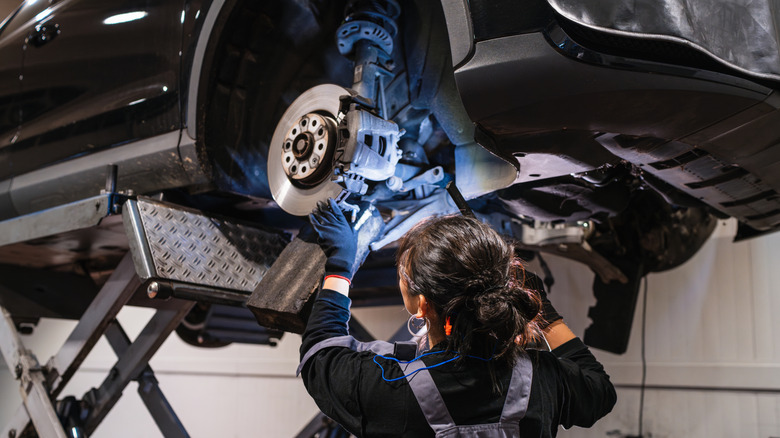
Brake pads are among the most misunderstood wear items on any vehicle. Many drivers assume they’ll get a clear, early warning — a squeal here, a grind there — but by the time those sounds arrive, the pads are already critically thin. On average, a typical set of front brake pads should last between 20,000 and 60,000 miles, a range wide enough to catch drivers off guard. The spread comes down to variables that are easy to overlook.
AutoZone explains that frequent city driving, heavy vehicle loads, and abrupt braking all accelerate wear, while noting that pad material is one of the primary variables determining how long pads last. Organic pads — the softest and quietest — can wear out in as few as 20,000 to 30,000 miles, while ceramic pads can last up to 70,000 miles under the right conditions. Front pads tend to wear faster than rears because braking shifts weight forward, increasing the load on the front axle.
Many drivers also fail to account for the impact of driving style: hard, late braking degrades pad material rapidly, potentially cutting service life way beyond the norm. The average cost of a brake pad set is between $320 and $379, though performance cars and luxury vehicles can run higher. The good thing is that you can check your brake pads without removing the wheel, so be sure to do so, regardless of what the package says.
Tires
Tires are the only part of your car in contact with the road, yet most drivers replace them reactively. The general idea is that — tires are fine until tread is gone. However, this misses a critical factor: age. Many automakers recommend replacing tires five to six years after their production date regardless of remaining tread life. Rubber compounds degrade over time even when a tire looks acceptable or has plenty of tread left.
As for mileage, the numbers vary more than most people realize. Consumer Reports‘ treadwear testing found that high-performing all-season tires last roughly 55,000 to 95,000 miles, but ultra-high-performance summer tires can wear out in as few as 25,000 to 30,000 miles. Driving style plays a major role: aggressive acceleration, hard braking, and sharp cornering can, according to Performance Plus Tire, reduce tire lifespan by up to 25%.
Electric vehicles are a growing concern in this space
Heavy battery packs and instant torque output accelerate tire wear compared to equivalent gasoline-powered vehicles. To check how old your tires are, look for the DOT number on your tires – the last four digits indicate the week and year of manufacture. If those digits are more than six years old, it’s worth a conversation with your tire shop regardless of what the tread looks like.
Timing belt
The timing belt synchronizes the crankshaft and camshaft, making sure that valves and pistons move in perfect coordination at all times. If the belt fails, the results can range from the engine simply dying to internal damage. This is particularly worrying with interference engines, where pistons and valves occupy overlapping space. The only surefire way to tell if your engine’s timing belt is bad is to visually inspect it for breaks, cracks, and scuffs.
AutoZone explains that timing belts are made of rubber and degrade from heat cycling over time, usually without any audible or visible symptoms until they snap completely. Most manufacturers recommend replacement every 60,000 to 100,000 miles, but age matters as much as mileage: a belt more than seven to ten years old should be considered for replacement regardless of how far the car has been driven.
A used car with 40,000 miles and a 12-year-old timing belt is just as much of a risk as one with 100,000 miles. RepairPal puts the national average cost for timing belt replacement between $882 and $1,285, a figure that reflects the process of accessing the belt and precisely tensioning it. Expensive? Yes. Still, it’s nowhere near as expensive as a complete engine failure.
Shocks and struts
Unlike a brake squeal or a battery warning light, degraded suspension typically gives no obvious alert — it just slowly worsens your car’s ability to stay stable, stop quickly, and keep tires in contact with the road. Richard Reina, Product Training Director at CARiD, told GEICO that “You’re not aware of the wear and tear that’s going on with the suspension over the thousands of miles and years that you own the vehicle.” In other words, it degrades gradually, and that can make it difficult to spot since there are no sudden drops in performance quality.
KBB reports that shocks and struts typically last between 50,000 and 100,000 miles. Such a wide range is indicative of how different variables can sway the number each way. With heavy use — rough roads, trailer towing, or carrying heavy loads – replacement could be necessary at 40,000 to 50,000 miles. In normal conditions where the suspension endures less stress overall, the reasonable expectation is 75,000 to 90,000 miles.
Worn shocks and struts can increase stopping distances, make your car more difficult to control, and lead to compounding damage on associated healthy parts. Moreover, winter road salt, potholes, and sustained rough-road driving all accelerate wear while causing corrosion that shortens component life regardless of mileage. Some people believe greasing your vehicle’s shocks and struts is going to help them last and perform better, but only do so if it’s recommended by your manufacturer.
Car battery
Car batteries are quite possibly the most deceptive part on this list. Most drivers believe they’ll get a slow start, a dashboard warning, or some other clear signal before a battery dies. In reality, many batteries fail without any meaningful warning at all. According to AAA, battery degradation is gradual — from three to five years. Still, a vehicle’s usage pattern dramatically affects that timeline.
So, what’s the average lifespan of a new car battery? It depends on the type of battery, maintenance, your driving habits, and the climate. Consumer Reports, citing AAA data, found that lifespan ranges from 58 months or more in northern U.S. climates down to fewer than 41 months in southern states, where heat accelerates internal corrosion and evaporates electrolyte fluid.
Frequent short trips are particularly damaging because the alternator never has enough time to fully recharge the battery. This adds to a cycle that builds up sulfation and effectively shortens the battery’s life. AAA recommends having any battery older than three years tested annually, not just when it seems slow to start. In warmer climates, that testing interval should begin even sooner — at two years — given how aggressively heat shortens battery chemistry.