
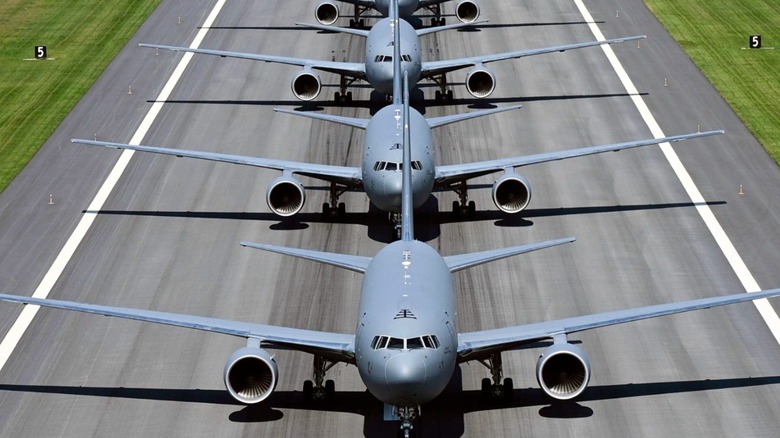
KC-46 Pegasus: The Troubled History Of The Air Force’s Largest Tanker
Fuel is the literal lifeblood of all military aircraft. Missions in contemporary times often demand that a crew take off in one part of the world, fly to a location on the complete opposite side of the planet, then return home. None of this is possible without the capabilities of in-flight refueling, such as that by the KC-135 Stratotanker. The Stratotanker has shouldered the burden of this task since 1957, but the U.S. Air Force recognized the need to modernize its aging fleet of tankers. They wanted a platform that would be more robust and versatile for its needs, and thus was born the KC-46A Pegasus.
The KC-46A was developed to be a replacement for the KC-135s, which have been in continuous service for over 69 years. This new state-of-the-art aircraft was designed to be more than just a gas station in the sky, but a multi-capable platform for the U.S. Air Force to accomplish a diverse array of missions. The KC-46A can transport a mix of passengers (15 seats for the aircrew, including aeromedical evacuation), pallets of cargo up to 65,000 pounds, and of course, in-flight refueling utilizing boom, drogue, and wing refueling pods. The KC-46A also boasts numerous defensive and communication measures, making it more resilient in conflict zones. These enhancements were substantial improvements over the KC-135, so the U.S. Air Force has been eager to get them out in the field and fully operational since the first craft was delivered in 2019. Unfortunately for the KC-46A Pegasus, achieving full operational status has been a bumpy and elusive road.
Persistent Gremlins in the works
A multitude of issues with the aircraft have followed it throughout its development. However, several specific deficiencies have proven to be resistant to a final solution. The first is that of the telescoping boom. The rigid centerline boom is the primary source of in-flight refueling for fighters and other planes, as it can transfer up to 1,200 gallons of fuel per minute. Made to work with a range of aircraft, this boom has repeatedly been determined to be so stiff that it is physically damaging aircraft. This was the case on November 7, 2022, when a F-22A Raptor in the process of refueling, in conjunction with several operational errors by the Pegasus boom operator and the Raptor pilot, resulted in $103,295.12 in damage. Work to mediate this issue has been ongoing with the FY 2025 Director, Operational Test & Evaluation report noting “improvements”, but the aircraft as a whole is “still below their threshold requirements.”
The second KC-46A issue is that of the Remote Vision System (RVS)
Together with the telescoping boom, the RVS is what allows the boom operator to maneuver the refueling boom into place for in-flight refueling operations. Unlike other refueling craft that relied on direct line of sight from a rear position, the KC-46A RVS positions the boom operator up front with the other crew, who then uses advanced technology, such as cameras and 3D displays, to carry out refueling. This technology has proven troublesome however, with it proving difficult for the operator to see the receiving aircraft properly in certain lighting conditions. This lack of visual clarity has resulted in unintended contact with receiving aircraft, thus causing damage. These issues have resulted in boom operators reporting eye fatigue and headaches. Improvements have been ongoing with software updates until Boeing, the manufacturer of the plane, can develop a new RVS system.
The KC-46A Pegasus program is still a work in progress
The KC-46A Pegasus, even with its persistent and consistent problems, continues to be acquired and rolled out to the U.S. Air Force. As of December 2, 2025, the 100th KC-46A arrived at Travis Air Force Base, California, when Gen. Johnny Lamontagne, commander of the Air Mobility Command, stated that “The Pegasus represents a key chapter in air mobility, one built on innovation and unwavering commitment to the mission.” The program is, in fact, moving forward for the Air Force to acquire more of the craft, with a request in the FY2027 Aircraft Procurement budget for 15 more KC-46A at a cost of $3.9 billion.
The modernization of the U.S. Air Force’s aging refueling planes brought about the KC-46A Pegasus. Its enhanced capabilities, greater payloads, configurability, and higher-capacity in-flight refueling made it a strong choice for such a job. All these enhancements have also brought a litany of pervasive ongoing issues, from stiff fuel booms to challenging RVS technology issues that have yet to be fully resolved. This hasn’t stopped the plane from deploying for service as the work to iron out the kinks continues.