
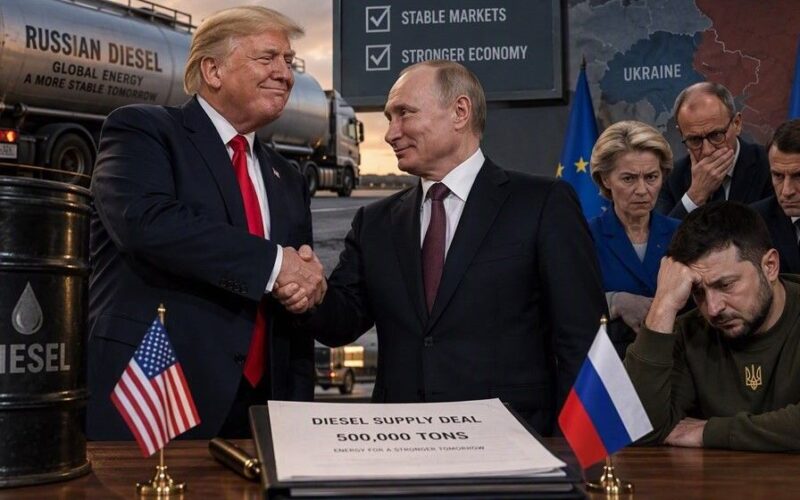
President Trump’s reaction after the diesel deal with President Putin captures the common definition of politics as the expression of interests. His stance tells us something cruder: in politics there is nothing but interests.
Viewed against the history of the European American alliance, Trump’s position was a painful slap to the European Union states, and to Ukraine behind them, mired in a long war with Russia.
Interests here are no minor matter in the calculations of Trump, whose party and the members of its strongest faction are fighting crucial midterm elections. What worries him most about the outcome is the effect of fuel prices on angry voters.
What did the allies offer Trump in these difficult times? Nothing, just as at other decisive junctures when he needed NATO’s support and did not find it. The war on Iran is the clearest proof of Europe’s letting America down.
At a moment when he badly needed help, the only one who extended a hand was the “enemy,” Putin, who drew on his precious diesel stockpile to supply 500,000 tons to make up the shortage in American and global markets.
It took nothing more than a phone call with Putin to solve a problem that haunts a president terrified of a blue wave that would spoil the last two years of his term and restrict the limits of his authority, the only thing he knows how to wield.
The Europeans understand this is no passing deal, which is why their anger erupted. And to Zelensky’s misfortune, having not learned the lesson of the famous White House meeting, he came out and criticized the deal directly. Trump’s response was stormy and crushing. He demanded that Zelensky resign immediately and that elections be held to choose his replacement, as if withdrawing recognition of the legitimacy of his presidency.
What Zelensky, and the European leaders behind him, fear is that the matter will not stop at this deal. Diesel diplomacy may have begun to reshape Washington’s position on the Russian-Ukrainian confrontation.
Trump values strong friends who stand with him in crises, and he cannot forget this gesture from Putin. In this regard, Trump will not start from zero. From the beginning he leaned toward the Russian vision for ending the war, and was more inclined toward the view that calls on Ukraine to accept the status quo and concede the territory it has lost, so as not to lose more.
The European Union and Britain stood against this vision of a solution and kept supporting Ukraine, without being able to decide the battle with Russia. Trump, for his part, treated the war as nothing more than a market for arms deals, under strict limits that give Ukraine no chance of missile superiority.
Over time, it appeared that the Trump administration had lost its diplomatic patience and no longer cared about an end to the war, given European intransigence.
But the diesel deal may change Trump’s mood and push his administration to intervene more roughly, pressuring Zelensky to accept unfair ceasefire terms and return to the negotiating table. Before that, he would have to accept the outcomes of the war. The announcement of a mutual halt to strikes on energy facilities is only the beginning.
Circulating reports point to an upcoming visit by Trump’s envoy to Moscow to build on the deal’s outcomes and open a diplomatic track that might give both sides a chance to agree on ending the war.
Zelensky must understand that what drives the Trump administration is the logic of deals and interests, and that is the condition of states in our contemporary world. Whoever cannot offer a winning deal will find no interest from the American administration.
Related Stories
Messages from Jordan's Public Finances

A gift from the sky for Netanyahu