The number of foreign fighters in Syria who fought the former regime and remain in various parts of the country reaches 50,000 by some estimates, while other estimates put it much lower, at around 10,000. Between the two figures, the fate of these fighters keeps coming up.
International and Arab capitals want to be rid of this mass of fighters by any means. They are of different nationalities and fall into several categories: Turkistani (“Uyghur”) fighters, fighters from the Caucasus and Chechnya, fighters of Uzbek and Kazakh nationality, and individuals from Arab or Islamic groups.
Official Damascus may also want to be rid of this mass, for many reasons. Among them is that the commitments agreed upon during the war against the regime have been backed away from by the new authorities, and there are signs of anger among members of these groups.
More than one scenario has been put forward. The first is to send them to Lebanon to wage a war against Hezbollah on a Sunni-Shiite sectarian basis. Although the involvement of these fighters in a war inside Lebanon might satisfy several parties there, it would mean stirring up Lebanese society along internal sectarian lines and causing security breaches, since these groups would enter through eastern Lebanon in openly unlawful fashion, though with political and security agreement, in line with regional and international wills.
For its part, official Damascus has denied any intention to intervene in Lebanon. That denial may have been aimed at the official forces rather than at any groups sent unofficially and without announcement.
The second scenario was recently leaked by American sources: sending this mass to Yemen to launch attacks and engage in an internal war against the “Ansar Allah” organization. This too would be a Sunni-Shiite sectarian battle, especially given the intense mobilization within these groups against Shiites everywhere.
These forces could reach Yemen’s borders only by sea or across the land border with Yemen, and such plans carry risks and security and political costs. Official Damascus has also categorically and completely denied the information recently leaked by the American sources via the Axios website.
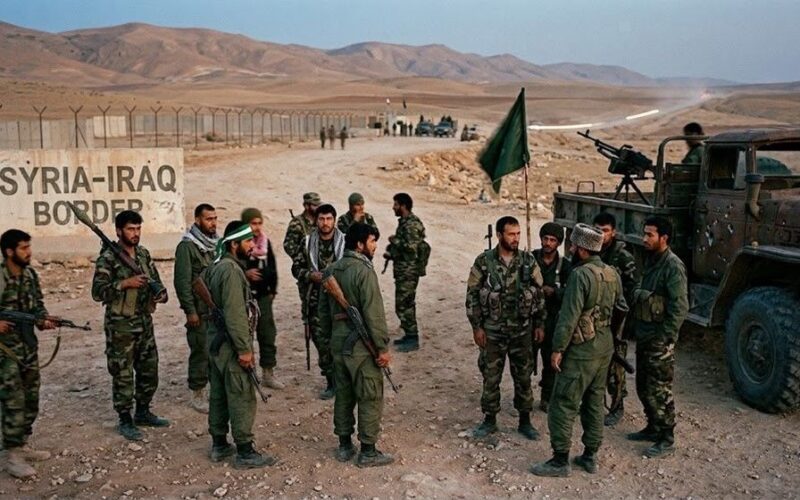
The third scenario concerning this fighting mass is to make use of it against Iraq, across the Iraqi-Syrian border, at some stage. It replicates the same scenario, a Sunni-Shiite war, especially after the American withdrawal from Iraq and with Baghdad regarded as Iranian in its allegiance.
The border between Syria and Iraq runs for more than 600 kilometers, and it is also open toward Jordan, which lacks nothing in the way of a sectarian war between extremist Iraqi groups and groups of every nationality fighting on a sectarian basis. There are also possibilities of a potential resurgence of ISIS, in the context of draining and weakening Iraq in a way that serves the battle with Iran.
Here we would face a Jordanian-Syrian-Iraqi border triangle open to every kind of military group, and the possibility of Jordan being forcibly drawn into the fight remains real.
Faced with the region’s crises, there are no solutions at the level of the region’s internal structure other than exploiting sectarianism, that is, the Sunni-Shiite conflict, by throwing in every kind of military group, creating new ones, and reviving groups whose strength had previously declined. This solution may serve American and Israeli goals as well, by making the region fight itself on behalf of the international centers of power.
As for the cost, we must pay attention to a dangerous point: investing in fighting groups of every kind, from the Popular Mobilization Forces in Iraq to ISIS and any fighting organizations that exist or will be established, will lead to the complete destruction of the region’s structure. It would turn the war from one revolving around the targeted states into one fought inside those states themselves, with consequences that at the very least include fragmenting the structure of states and preparing them for partition along sectarian, confessional, and ethnic lines.
We must also reflect at length on this strategic shift: the existence of fighting groups of every type, orientation, and sect that are available for hire in this region afflicted with every kind of crisis.
Related Stories

The Disarmament Scenario