
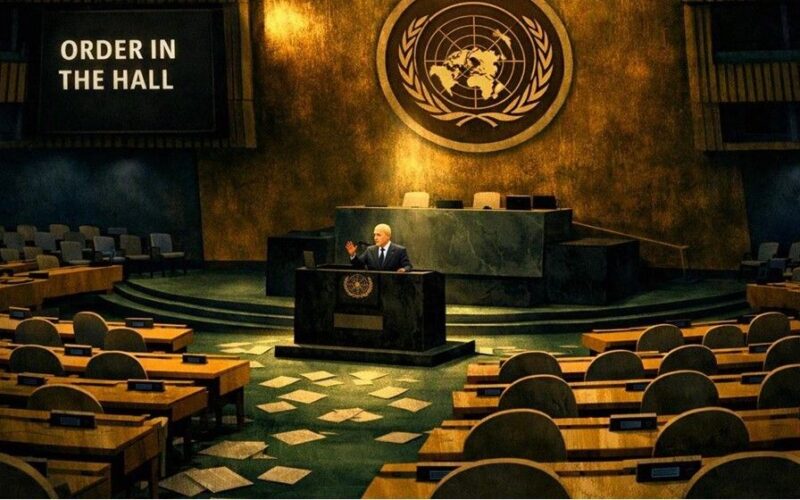
I decided to listen to Netanyahu’s speech and haven’t witnessed such an absurd political scene in a long time. A man standing on the podium of the United Nations to address the world, while the world itself almost decides to walk out of the hall!
This is how Benjamin Netanyahu began his speech to the UN General Assembly: dozens of delegations rose from their seats and left, large sections of the hall became empty, and the man continued speaking as if nothing had happened. Even the president of the General Assembly had to repeatedly request: “Order in the hall.”
That’s when I thought to myself: why not create a new award in international politics? “Best Actor in Political Discourse.” And I believe Netanyahu deserves to enter that competition strongly.
Not because of what he said necessarily political lies require an independent investigation of each claim, not journalistic impressions but because the man presented a striking model of transforming political discourse into a theatrical performance: stories, accusations, pictures, devices, threats, messages, and then accusing anyone who doesn’t applaud him of not understanding the truth.
What’s most amusing is that the audience itself was telling him something entirely different by walking out of the hall.
Instead of wondering why such a large number of world representatives were leaving, Netanyahu decided to give them a moral certificate, describing those departing as “moral cowards,” even calling on the remaining ones to leave as well!
Imagine a player entering a stadium, the audience leaving the stands, then turning to the empty seats and saying: “You don’t understand the game!”
Netanyahu’s speeches always have the same problem: transforming every political narrative into a single truth, then treating every other narrative as lies or conspiracy. He said Israel didn’t commit genocide but prevented genocide, accused his opponents of spreading lies, attacked the mayor of New York, attacked Qatar and Turkey, and presented himself and his government as the only side that knows the truth. Then came the accessories: a “pager” device raised before the world, a “Starlink” device waved about, as if we were watching a TV program rather than the UN General Assembly. Frankly, I expected at some point for him to pull a remote control from his pocket and say: “Now let’s move to the second segment of the show.”
But there was one thing Netanyahu couldn’t control: the chairs. The chairs don’t lie. Dozens of delegations left. The cameras captured the empty seats. And the hall that was supposed to be a stage for a display of power became the best silent critic of the speech.
And the paradox was that Netanyahu was talking about truth, while the scene before him was saying something entirely different. People might disagree on words. They might disagree on narratives. They might disagree on politics. But it’s hard to argue with a picture of empty seats. Seats don’t vote, they don’t flatter, and they don’t fear Netanyahu.
And that was the best moment of the entire speech. It wasn’t a sentence Netanyahu said. It was the moment when the audience decided to respond in its own way: we don’t want to hear the rest of this play. But the actor remained on stage. He continued talking. He continued with accusations. He continued presenting the evidence he had chosen. He continued speaking to the cameras. But the audience had already spoken.
For this reason, if the United Nations ever decides to award the “Most Persistent Political Actor Award for Continuing the Performance Before Empty Seats,” I suggest Benjamin Netanyahu be the first name on that list. Not because politics is theater. But because some politicians, when they lose their audience, don’t leave the stage. They continue performing… even after the show has ended.
Related Stories

Europe and the Retreat of the Welfare State
Will Netanyahu Succeed in Igniting the War the World Fears?