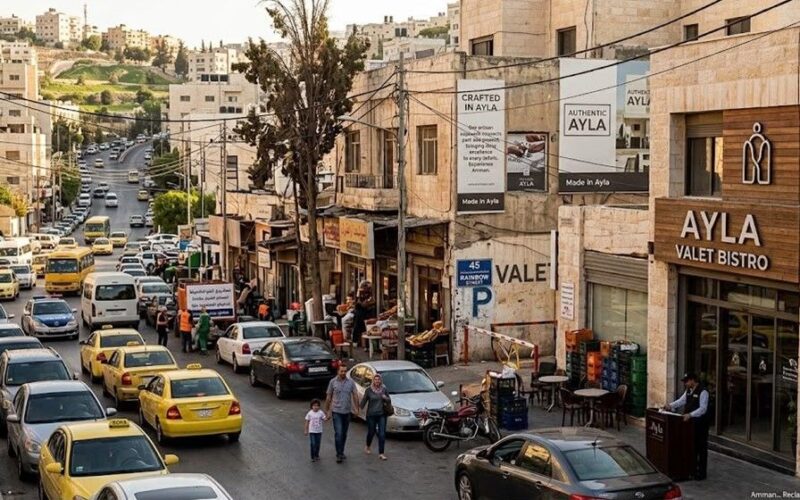
Over time, some forms of disorder in the capital, Amman, have become entrenched behaviors. Some people view them as entitlements that must not be touched. This is the most difficult challenge facing any effort to reorganize the city, restore the image it deserves, and improve the efficiency of its traffic and economic activity.
Traffic congestion is one of the most prominent signs of this disorder. Some businesses have taken over sidewalks; parts of streets and public spaces have been turned into private parking; and valet parking has spread, at times beyond the bounds of regulation. These practices also encroach on pedestrians’ right to use sidewalks, obstruct and close entrances and passageways, and treat public space as if it were private property.
Such practices increase the cost of travel and transporting goods, consume workers’ time, and make it harder to reach shops and services. Using public facilities for the benefit of particular businesses also undermines fair competition, while making citizens and other businesses bear the cost of that private use.
Addressing the problem becomes harder when some of these practices take on an organized character, especially in the areas of parking and valet services. Tackling them requires the law to be enforced consistently and genuine cooperation among the various authorities involved.
Weak oversight and enforcement have also played a role: periods of leniency in regulating parking and monitoring cleanliness allowed practices to accumulate that have obstructed movement and marred the capital’s appearance.
The municipality must take responsibility for addressing the problem, review and correct the decisions and procedures that contributed to these imbalances, remove violations, and enforce the rules consistently to prevent them from recurring.
In this context, the work currently being carried out by the Greater Amman Municipality is a clear attempt to address the accumulated effects of many years, reassert order in public spaces, and remove eyesores that have become part of the capital’s daily landscape. The municipality is dealing with an interconnected set of problems involving traffic bottlenecks, parking, sidewalks, cleanliness, tree planting, and green spaces.
The Greater Amman Municipality remains responsible for its core duties: keeping the city clean, providing parking, properly applying building standards, and addressing the consequences of past leniency in a way that prevents the same problems from recurring.
The success of these efforts cannot be the municipality’s responsibility alone. Reorganizing Amman requires ongoing institutional coordination among the municipality, security and oversight agencies, and the relevant ministries. It also requires cooperation from business owners and citizens themselves.
We cannot demand a beautiful, well-organized city and then object to the removal of a violation simply because we have grown used to it. A violation cannot become an acquired right merely because people have become accustomed to seeing it.
Cleanliness is another fundamental challenge. Amman needs to renew its attention to the cleanliness of its streets, neighborhoods, and squares, and establish a clear program for planting trees and expanding green spaces. A city’s cleanliness and organization are part of quality of life and of the capital’s appeal for investment, tourism, and business.
What is happening today should be viewed as a project to reorganize the capital. It aims to restore a balance between economic activity and citizens’ right to a well-organized, safe, and clean city. That requires clear regulatory procedures, practical alternatives for parking, and easy access to commercial establishments.
Amman deserves to regain its vitality. The work the municipality has begun needs to continue with firmness and cooperation. Addressing the accumulated problems of many years requires sustained effort, and it is possible when public order is protected institutionally and its rules are applied to everyone.
Related Stories

How Did Royal Jordanian Profit in Times of Crisis?
Parties Showed Up, but Party Life Is Absent