
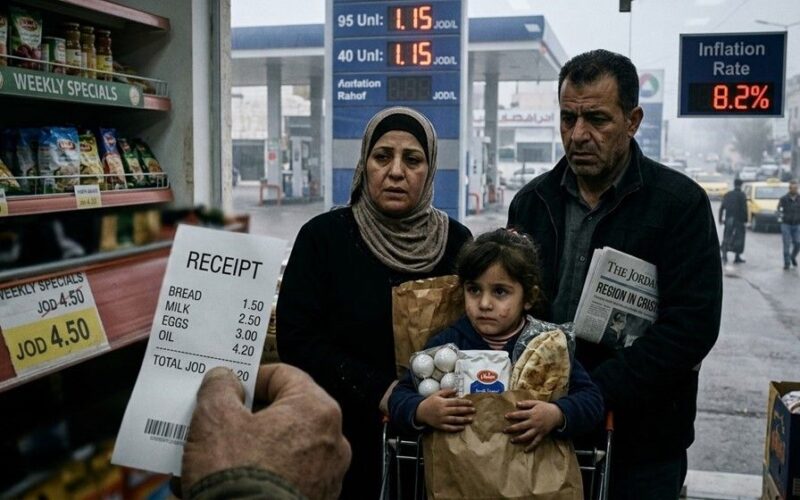
The world has not yet recovered from the waves of high prices that followed the COVID pandemic and the Russian Ukrainian war, and already signs are gathering that point to additional waves of inflation. The fallout from the American Israeli war on Iran, and its entry into a medium to long term war of attrition, along with disruptions to energy supplies and shipping traffic through the Strait of Hormuz, the Red Sea, and Bab el Mandeb, alongside the escalating war in Ukraine, are all factors pushing energy, transport, and insurance prices upward, with their costs then gradually passing through into the prices of food, goods, and services.
A few days ago, the IMF’s managing director warned that the world may be more optimistic than it should be about the scale and duration of the energy shock. The fact that the global economy has held up so far does not mean the danger has passed, especially with oil, gas, and petroleum product prices continuing to climb, and countries’ ability to keep drawing on their reserves to offset supply shortfalls diminishing.
But the more important question here isn’t only how high inflation will climb, but who will pay its cost. Inflation isn’t merely an economic indicator that rises or falls; it is a process that redistributes income and wealth within societies. When prices for food, energy, housing, and transport rise, not everyone bears the same burden. Poor and middle income households spend most of their income on these very needs, so any increase in their prices directly eats into their ability to get by.
Those with high incomes and wealth, on the other hand, have a greater capacity to absorb rising prices, and many of them also hold real estate, stocks, and assets whose value can rise along with inflation. Inflation can therefore function, in practice, as an unannounced mechanism for transferring part of income and wealth from groups that depend on wages and fixed incomes toward groups better able to protect their wealth.
This means that new waves of inflation, if they continue, will push toward greater social disparity and economic inequality worldwide. Wages typically do not rise as quickly as prices do, and so their real value declines. Retirees and those on limited incomes are more exposed to this loss, while tens of millions of households around the world find themselves forced to cut their consumption of food, health care, or education in order to cover basic expenses.
The picture becomes even harsher in countries of the Global South, which import much of their energy and food needs while simultaneously suffering from rising debt and weak social protection systems. As the cost of servicing debt rises, governments’ capacity to increase social spending narrows at precisely the moment citizens need it most.
Fighting inflation by raising interest rates also carries its own social cost. Higher interest rates increase the cost of borrowing for households and companies, and weaken investment, growth, and job creation. In this way, broad segments of the world’s population may find themselves facing a difficult equation: higher prices, lower real wages, more expensive loans, and weaker job opportunities.
More dangerous still is that a later decline in inflation does not mean prices return to their previous levels. When inflation later falls, that simply means prices are still rising, just at a slower pace. So economic indicators may improve even as people continue to suffer from high costs of living.
For this reason, the coming waves of inflation should not be treated as a matter concerning central banks alone, to be addressed through the usual monetary policy tools. At its core, this is a matter of social justice and the distribution of income and wealth. Confronting it requires, alongside monetary policies, protecting real wages, expanding social protection, safeguarding spending on health and education, and building fairer tax systems.
Related Stories

The Displacement of Palestinians Between Two Dates

Settling scores through war