
The World’s Smallest Electric Motor Has To Be Viewed With A Microscope
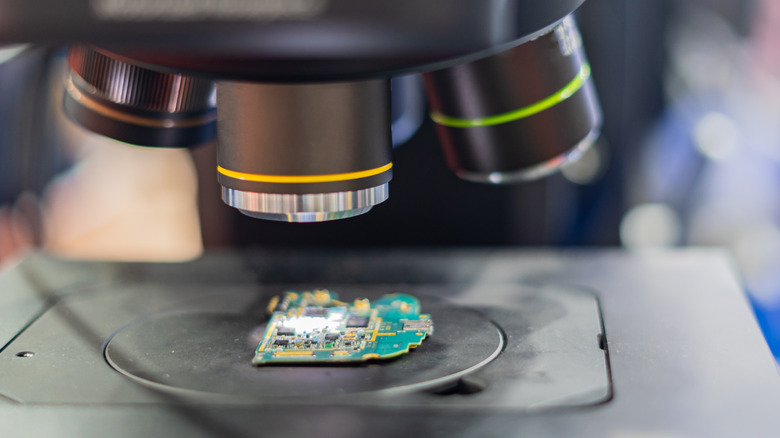
Some of the largest engines ever built get talked about a lot, but the other end of the spectrum doesn’t always get the same attention. Yet the smallest working electric motors are arguably equally impressive. The world’s smallest motor, for example, is so small that it requires the use of a special kind of microscope called the scanning tunneling microscope, which is capable of making out a single atom.
Developed by a team from Tufts University in September 2011, this single-molecule motor still holds the Guinness World Record for the smallest electric motor today. Unlike the electric motor in something like a Tesla, which spins using magnets and coils, this molecule behaves more like a biological system than a machine. The tiny motor is a molecule of butyl methyl sulphide, which is basically a sulphur atom in the middle with carbon and hydrogen arms hanging off either side. It was selected for the task because of an interesting little quirk: its lopsidedness. One of its “arms” carries four carbons while the other carries just one. This quirk helps the whole thing spin, with the sulfur atom working like a pivot.
Size-wise, the motor measures 1 nanometer across, which is one-billionth of a meter. It’s so minuscule that even a strand of human hair runs roughly 60,000 times wider than that. For comparison, the previous record-holder for the smallest electric motor measured 200 nanometers across.
How the world’s smallest electric motor works
Since this is an electric motor, you can guess what actually enables the molecule to spin. That scanning tunneling microscope mentioned above actually sees molecules using electrons rather than light, and it’s these electrons that help the whole thing spin. The microscope has this metal tip at the end, which funnels charge straight into the molecule.
To have this function, the team also had to conduct the experiment at roughly -450 degrees Fahrenheit, which is just a sliver warmer than absolute zero at -459.67 degrees Fahrenheit. The reason for this is because anything warmer would make the molecule spin too fast for scientists to properly register it. For reference, the molecule whips around more than 1 million times every second at 100 Kelvin. Cooling slows it down to something manageable, like around 50 spins per second.
There are several different ways a mini electric motor like this could be used, but many of them involve the medical field. For example, certain medical devices use pipes that are so thin that the liquid inside drags against the walls, affecting its movement. Coating those walls with motors could help push it along smoother. Coupling several of them together could also be a way to form small mechanical parts like gears and use them in the electrical circuits of things like cell phones.