
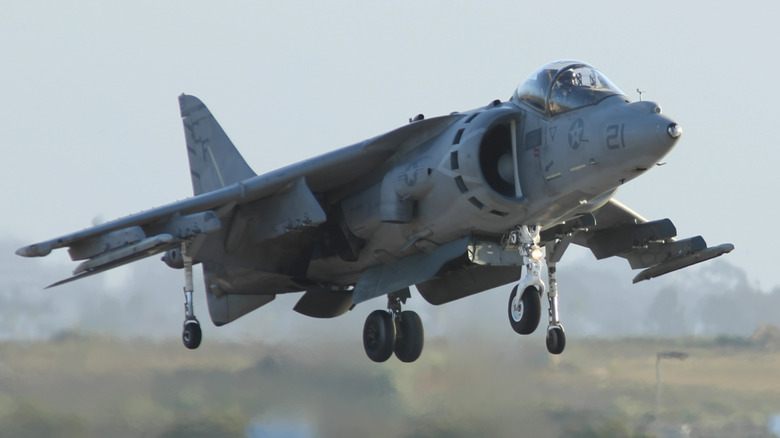
US Marine Corps Retires Legendary ‘Jump Jet’ After 55 Years In Service
Certain attributes can lift an aircraft from being just another airplane to attaining legendary status. Take the Spitfire, for instance. This fighter earned its reputation during a few short years in World War II, where it played a critical role in the Battle of Britain. It was also one of the fastest fighters of World War 2. Then there’s the B-52, a plane with legendary longevity and a service career that‘s expected to last for over a century. The A-10 Warthog, an unusual plane designed for a very specific task, is also one of the most treasured aircraft in the USAF lineup.
The U.S. Marine Corps’ AV-8B II Harrier “Jump Jet” is also a plane that has attained legendary status. Now, after a career that’s spanned 55 years, the legend has retired from active service. On June 3, 2026, five Jump Jets from Marine Attack Squadron 223 took off from Marine Corps Air Station Cherry Point to perform the final flypast, marking the jet’s withdrawal from active service.
This was a plane that had vertical/short takeoff and landing (VSTOL) capabilities that were decades ahead of their time, which undoubtedly helped the Harrier secure its role in history. Let’s take a closer look at the history and career of a Marine Corps legend, including its role as one of the most important weapons of Operation Desert Storm.
The U
S. bought its first AV-8B II Harrier Jump Jets in the ’70s Yo momma12793/Wikimedia Commons/CC BY 4.0 Despite its long association with the U.S. Marine Corps, the first of these jets was actually built by the Hawker Siddeley Aviation factory in the U.K. The thing that made the jet stand out right from the outset was its VSTOL system. The Harrier was powered by a single turbofan jet engine that used a vectored-thrust system, able to divert the engine thrust through rotable exhaust ports. It’s worth remembering that this was in a time before complex flight computers could monitor every movement and make the adjustments necessary to keep the jet stable.
The unique features of the aircraft attracted American interest, and by 1970, the Marine Corps had placed its first order of 102 AV-8A Harriers. These were essentially the same as the British version, but built with American weapons systems, flight controls, and avionics. The first planes were delivered to the Corps in 1971. Although the plane has British roots, the AV-8B II Harrier was a redesign led by McDonnell Douglas, with British Aerospace as a partner. This AV-8B version entered service in 1985, and about 337 were built before the last Harrier rolled from the production line in 2003.
How the AV-8B II Harrier Jump Jet became a combat legend
The Harrier Jump Jet had some unique attributes that helped secure its longevity, including its ability to take off from just about anywhere. This is an obvious advantage, but one that would be meaningless if the aircraft couldn’t perform in combat. The first major combat <a href="https://jordangazette.com/4-pickup-trucks-to-test-drive-if-you-love-your-toyota-tundra/”>test for the Jump Jet came during the Falklands Conflict in 1982. An initial force of 20 British Sea Harrier Jump Jets was outnumbered by about five-to-one by Argentinian fighters. Despite initial expectations that Sea Harrier losses would be heavy, the jet suffered no air-to-air combat losses and downed 20 Argentinian fighters.
It was just under a decade later, in the 1991 Gulf War, that the AV-8B Harrier II proved itself in American colors. During the conflict, the aircraft flew over 3,300 missions. Among others, it also saw action in Afghanistan in the early 2000s, Operation Iraqi Freedom in 2003, and operations in Syria and the Red Sea. The legendary jet’s final combat missions took place in the Caribbean Sea, and this aircraft was involved in the capture of Venezuela’s President Nicolás Maduro. Ultimately, it took the introduction of the F-35B, one of the most advanced jets in the world, to trigger the retirement of the legendary Jump Jet.