
The Phenix
Center for Economic and Informatics Studies warned that the Arab region is
facing a deep and worsening youth employment crisis, stressing that the
continuation of current economic policies without serious review risks creating
a “bleak future” for large segments of Arab youth.
The warning
came in a report by the Center analysing the findings of the International
Labour Organization’s Global Employment Trends for Youth 2026, which
showed that Arab States recorded the highest youth unemployment rate among all
regions of the world.
According to
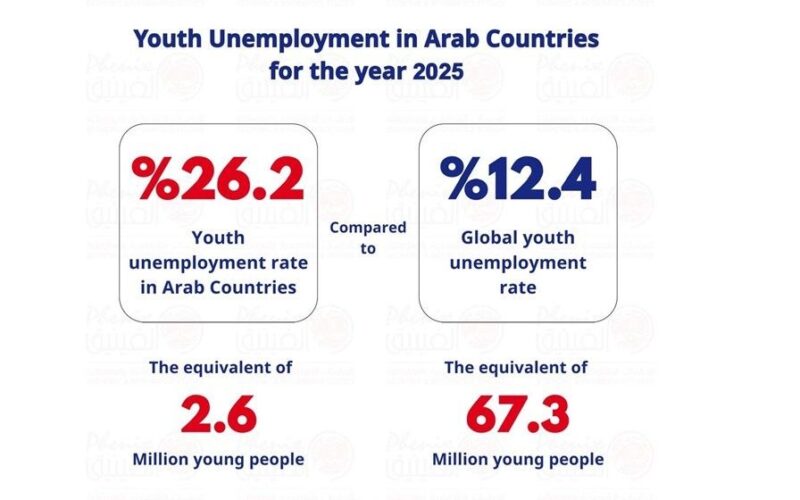
the report, the youth unemployment rate in Arab States reached 26.2 percent in
2025, more than double the global average of 12.4 percent. The number of
unemployed young people in the region stood at approximately 2.6 million and is
projected to rise to 2.8 million by 2027, while the unemployment rate is
expected to remain at around 26 percent over the coming years.
The Phenix
Center noted that the limited recovery witnessed in youth labour markets
globally following the COVID-19 pandemic has stalled.
The global youth
unemployment rate rose again to 12.4 percent in 2025 after reaching its lowest
level in two decades in 2023, bringing the number of unemployed young people
worldwide to 67.3 million.
The Center also noted that young people are now more
than three times as likely to be unemployed as adults, reflecting the
increasing difficulty faced by new entrants in securing their first job.
The report
highlighted that an even more alarming indicator is the proportion of young
people who are not in employment, education or training (NEET). In Arab States,
this rate reached 32.4 percent in 2025, meaning that approximately one in every
three young Arabs is outside both the education system and the labour market.
This represents 11.6 million young men and women, a figure expected to rise to
12.2 million by 2027. The Phenix Center warned that prolonged exclusion from
education and employment increases the risk of skills erosion and declining
trust in institutions, while making it increasingly difficult for these young
people to return to economic activity over time.
One of the
report’s most significant findings is that higher education does not provide a
guaranteed pathway to employment in the Arab region.
On the contrary, the
unemployment rate among young university graduates stands at approximately 25.6
percent, compared with only 8.6 percent among those with secondary education
and 9 percent among those with basic education.
The Phenix Center attributed
this paradox to the limited capacity of Arab economies to generate jobs that
correspond to young people’s rising educational attainment, particularly as
these economies continue to depend heavily on sectors with limited added value.
The report
also revealed a severe gender gap in the Arab labour market. Globally, the NEET
rate among young women reached 27.4 percent, compared with 13.1 percent among
young men.
This gap is even more pronounced in the Arab region and North Africa
due to the burden of unpaid domestic and care work, inadequate childcare
services, discrimination in the labour market, and limited access to safe
transportation.
The Center stressed that the narrowing of the gender gap in
education in many Arab countries has yet to translate into comparable economic
gains for women.
The Center
also warned that rapid technological transformation, particularly the expansion
of artificial intelligence, is entering Arab labour markets that already suffer
from deep structural imbalances, potentially making its effects on young people
more severe than in other regions of the world.
According to the UN report,
around 6.1 percent of youth jobs globally are highly exposed to the effects of
artificial intelligence, and approximately 5.6 million young people could lose
their jobs if only 10 percent of these highly exposed positions were
eliminated.
The Center
pointed out that medium-skilled jobs, including clerical and administrative
occupations that have traditionally served as an entry point for Arab youth
into the labour market, are among the categories most vulnerable to decline.
The Phenix
Center argued that the consequences of these structural imbalances extend far
beyond the labour market.
They delay young people’s economic independence,
reproduce poverty across generations, widen social inequalities, and weaken
trust in institutions and public policies, thereby increasing the risk of
social and political tensions.
The Center stressed that these challenges cannot
be addressed through security-based approaches, as they are fundamentally
economic and rights-related crises that require structural solutions.
The Phenix
Center called on governments across the Arab region to move away from treating
youth employment as a narrowly defined sectoral issue managed primarily by
ministries of labour.
Instead, youth employment should become a central
objective of all economic and investment policies, with such policies assessed
according to their actual capacity to create decent jobs, rather than solely on
the basis of overall economic growth rates.
The Center
also called for expanding social protection systems to cover emerging forms of
employment, increasing investment in high value-added sectors such as health,
technology and engineering, and developing flexible education and training
systems capable of keeping pace with rapidly accelerating economic and
technological transformations.
Related Stories