
<a href="https://jordangazette.com/whats-the-average-car-insurance-rate-at-every-age/”>What Is The US Military’s Longest Range Air-To-Air Missile And How Far Can It Go?
Throughout most of the early to mid-20th century, air-to-air combat involved shooting bullets at a target to take them out of the fight. This practice continued through World War II, but the invention of reliable air-to-air rockets around that time allowed aircraft to remain further apart and strike targets before being seen. The United States’ first air-to-air missile (AAM) was the Hughes AIM-4, which entered service in 1955, and the nation’s technology has advanced significantly since then.
Each new generation of AAM improved on previous designs, with developments such as the now 70-year-old AIM-9 Sidewinder – one of the most-used AAMs in the world – allowing for greater range and lethality than older missiles. While the U.S. can’t lay claim to having the most powerful AAM ever used in combat, a missile’s range is also vitally important, and the U.S.’ latest missile, the AIM-174B, outperforms anything else in the battlespace in that regard.
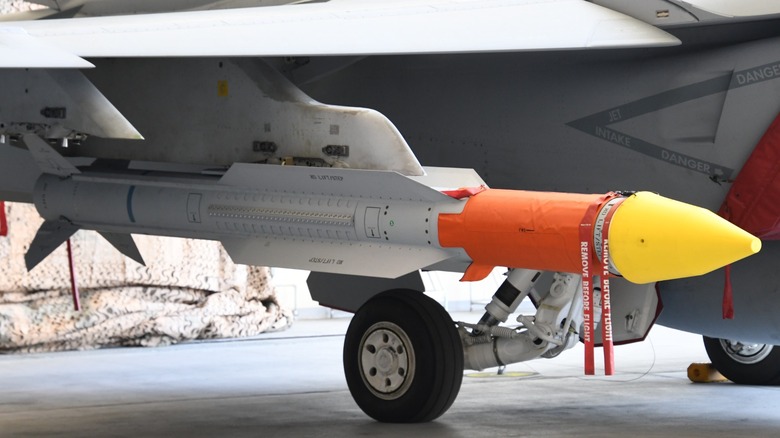
The AIM-174B Gunslinger, first photographed in September 2024, is a very long-range AAM developed by Raytheon for the U.S. Navy’s F/A-18F Super Hornets. These new missiles have a range of over 200 miles, though it’s believed they have an even greater range that the military has yet to confirm publicly.
The incredible range of the AIM-174B Gunslinger U
S. Navy/Wikimedia Commons If the goal of an AAM is to put as much distance between the firing aircraft and its target, then the AIM-174B lives up to that goal. As the world’s militaries transition to newer fifth-generation fighters, longer-range AAMs will ensure that legacy aircraft remain competitive. Allowing a 4.5th-generation F/A-18F Super Hornet to fire a missile from a safe enough distance to stop it from being overtaken or detected by an advanced Chinese fighter jet like China’s fifth-gen Chengdu J-20 “Mighty Dragon” means that the older plane can continue serving for longer than it otherwise might.
The AIM-174B’s range of 200-plus miles is quite substantial for an AAM. The distance these new missiles can fly is about the same as the distance between Boston and New York City. While a pilot’s visual range is limited to what they can see through their canopy to the horizon, radar and other means can identify targets at considerably greater ranges. The latter technology allows fighter pilots to unleash an AIM-174B long before entering dogfighting range.
Additionally, the missiles aren’t limited to striking enemy fighters and bombers. They can target other munitions or be converted to strike ground targets, making them incredibly useful and dangerous to the enemy.