
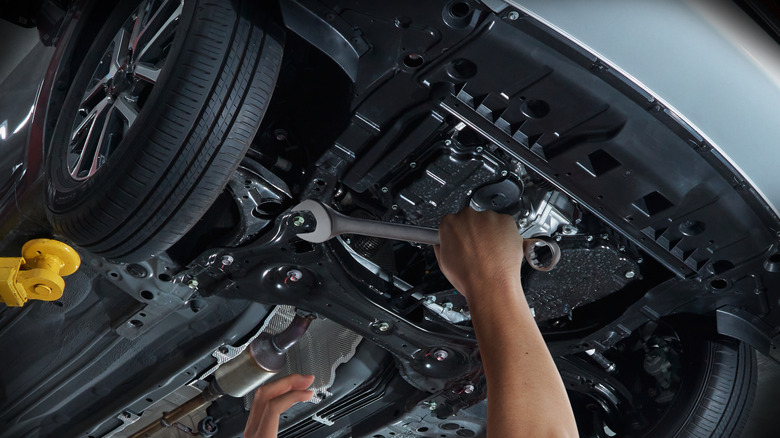
Half a century ago, hitting 100,000 miles meant the end of the road for your car. (Or, at least the end of the odometer.) But today, it might only be the midpoint. So long as you keep up on your maintenance, modern vehicles can last far longer than they once did. It’s now perfectly common to see a properly maintained car go beyond 200,000 miles. But it won’t happen by accident. You have to make sure you stay on top of its critical parts.
For the sake of your car, it helps to treat the 100,000-mile mark as a checkpoint. We’ve put together five of the most essential parts you should replace once you cross the six-figure threshold. You might’ve already swapped out some of these, but it’s still worth double-checking the list and taking care of any parts you haven’t replaced yet. Otherwise, age and wear can lead to sudden breakdowns, poorer performance, maybe even catastrophic engine damage.
Spark plugs
Today’s spark plugs last so much longer than yesterday’s, but that doesn’t mean they last forever. Decades ago, people had to replace these things every 12,000 miles or so. But thanks to modern advancements, spark plugs can now last you up to 100,000 miles. We don’t recommend pushing them much further than that, though.
After all, these small parts play a huge part in how your engine runs
They generate the electrical spark that ignites the air-fuel mixture inside the combustion chamber, creating the controlled explosions that power your engine. When spark plugs start to wear down, you might notice rough idling, hard starts, engine misfires, sluggish acceleration, and worsening fuel economy. But you can avoid all that by simply replacing them at 100,000 miles.
(Some vehicles might need replacements much earlier, around 30,000 miles, but times that by three, and the 100,000-mile mark still means it’s time to replace.)
Tires
By the time a car reaches 100,000 miles, it’s almost certainly gone through at least one set of tires already, if not more. But because most tires last around 50,000 miles, depending on driving habits, the 100,000-mile mark still makes for a good time to replace. Some of the best-performing tires can last all the way to 100,000 miles, so those should be replaced, as well.
Tread wear is the most obvious tell. Tires lose traction as their tread depth decreases, which is why federal guidelines say your tires should be replaced once tread depth reaches 2/32 of an inch. (Or sooner than that, especially if you want better performance and braking.) But drivers should pay attention to more than tread depth alone. Uneven wear patterns are another crucial warning sign to replace, as are cracks, bulges, punctures, or sidewall damage. Still, even if things look good at 100,000, you shouldn’t push them much further.
Timing belt
Unlike worn tires or aging spark plugs, a bad timing belt might not give you much of a warning before it goes. That’s why sticking to the 100,000-mile guidance is so imperative. The timing belt synchronizes the crankshaft and camshaft so that the valves open and close at precisely the right moments during combustion. (In some designs, the belt also drives the water pump.) If that belt slips or breaks, the engine can get thrown out of sync instantly.
That’s especially dangerous in interference engines, where pistons and valves share the same physical space. If the timing belt fails but the crankshaft keeps spinning, your pistons can collide with the open valves. Simply put, that’s very bad. Repairs can easily run into the thousands of dollars. So when automakers recommend replacing the timing belt somewhere between 60,000 and 100,000 miles, you definitely don’t want to put that off.
Battery
If you drive a gas-powered car, your vehicle’s battery doesn’t necessarily come with any sort of mileage-based guidance. It’s more every 3-5 years. But if you drive a hybrid? The 100,000-mile mark is the time to start thinking about a replacement. Most hybrid battery packs tend to last between 100,000 and 150,000 miles. That’s thanks in large part to EV-related federal regulations, which require warranties of at least eight years or 100,000 miles.
For gas-powered cars, that guidance about 3-5 years might just put you at 100,000 miles anyway. If not, look out for some signs of a weak battery. That includes sluggish starts, dimming lights, or dashboard electronics that reset during ignition. (Of course, batteries can also just fail out of nowhere without much warning at all. We’ve all been there once or twice.) Physical inspection is another good rule of thumb. Look for corrosion around terminals or any swelling, bloating, or leaks. These are all signs of a battery that needs to be replaced pronto.
Cooling hoses
Like the timing belt, cooling hoses love to go out without warning. These rubber hoses are what carry your vehicle’s coolant throughout the engine and radiator system. That, in turn, helps regulate the engine temperature and prevent overheating. And while modern hoses are much more durable than earlier versions used to be, even the strongest hoses eventually degrade. Usually, that’s around 100,000 miles.
If you’re coming up on that mark, some visual and physical signs can help you get a better idea of exactly when you’re due. Healthy hoses should feel firm yet flexible and quickly return to their shape when squeezed. Spongy, brittle, hardened, or swollen hoses are all signs of hoses gone bad. Same for any cracks, splits, leaks, or mushy sections. Ignoring the mileage recommendation (or, worse, any of the physical signs of degradation) can bring some serious consequences. Change these hoses around 100,000 miles to be safe.
Methodology
We selected these five components based on their likelihood of wearing down around the 100,000-mile mark. Information was drawn exclusively from trusted automotive sources such as AutoZone, Kelley Blue Book, AAA, and Edmunds. While other parts may also need replacing around 100,000 miles, we gave priority to parts that can create the most expensive secondary damage or significant safety risks if left unaddressed.