
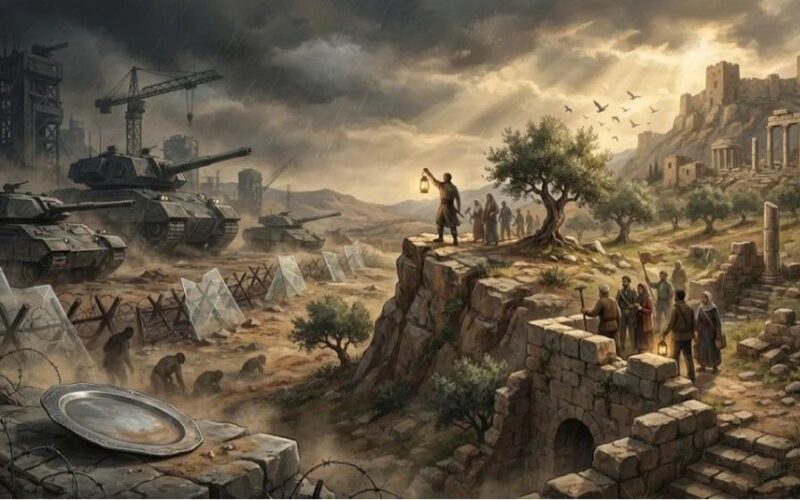
There is a sensitive idea that many people avoid raising, dismissing it as a purely emotional notion that does not survive contact with reality. The practical current does not believe in such ideas, seeing them as a form of wishful thinking and continuous sedation.
Faced with the plans of the United States and Israel in the region, everyone resigns themselves to the outcome. Rarely does anyone talk about other possibilities. Everyone wrings their hands, taking it for granted that what Washington and Tel Aviv want will happen in full and in every detail, with no resistance, no obstruction, no failure, no retreat and no regret.
This is an immersion in negativity, and an acknowledgement that this region is on its way to being re-engineered, its identity erased entirely, all its resources looted and foreign will imposed on its peoples and their future.
Throughout history this region has seen many occupations. States have risen and other states have perished, and the peoples of the region have paid a heavy price. But the region remained, and its peoples remained. The occupations passed away, and the schemes to seize the region’s identity failed. Anyone who looks back at history will discover that greed for the region and the targeting of it are not new. Disasters struck it continuously before today’s American-Israeli plans. No one denies that all these occupations, waves of crossings or invasions exhausted the region. But in the end they departed, due to various factors, at particular moments when other circumstances emerged that defeated every attempt at re-engineering.
Today, every factor in the region is colliding with the American-Israeli plan. Iran is being invoked, and perhaps Turkey later, as a pretext for targeting the region and its peoples. There are direct and indirect occupations, and attempts to grind the region and its peoples into conflicts they never wanted in the first place. If the cost has been high until today, this does not mean we are facing an inescapable end, or that the region is unable to generate routes to salvation, or that its people must surrender under the weight of targeting and the accumulation of pressures from every direction.
This means that the American-Israeli plan, and the role of additional powers, is not necessarily going to succeed completely. If it succeeds temporarily, it will not last forever. The region must therefore defend itself first, and its peoples must understand that we are not facing a matter of fate and destiny, however great the strength of the other parties.
The region contains many factors that can defeat every attempt at targeting. These factors are complex, and the clearest proof of this is that for 100 years the region has been subjected to attempts at division, sabotage and impoverishment, in which some client regimes sometimes took part. Yet the region is still able to send messages of resistance and to put them into practice on the ground, under different banners. This means that the bitterness of the price we all pay today does not mean surrender, nor handing the region over on a silver platter to its adversaries, because that would be a catastrophic investment in submission.
Over the past hundred years, Israel has been nothing but the cornerstone of the larger project. That is why it is protected by international powers that see it as a representative base, in whose roles every title of past occupations and religious and national enmities is concentrated. Since its founding until today, it has spread ruin everywhere. This means its functional role has a limit it cannot exceed, however great its victories may be by its own definitions.
We face two options. Either we bear the exhaustion of the region and defend it, and its causes, until the wave of the last hundred years passes. Or we surrender and abandon all these causes, and at that moment, gentlemen, we will pay the price twice.
Related Stories
Jordan's First Blue Loan Bond Marks a New Era in Strategic Project Financing

Netanyahu: The Actor Who Lost His Audience But Remained on Stage