The United States has a racist president who fuels hatred and conflict within his own country and seeks to spread this virus to other peoples, particularly Europeans, as part of a campaign that increasingly targets Arabs, people across the region and all Muslims without distinction.
At an election rally, the US president mocked the name of the Prophet Muhammad (peace be upon him). He said that if you called out to someone in the Middle East whose name you did not know, there was a 65% chance that his name would be Muhammad. He claimed he had tried this approach and that it had worked. The remark was an attempt to ridicule Muslims and take a swipe at Islam and the Prophet, after whom Muslims love to name their children.
It is difficult to tell whether he was genuinely making fun of others, mocking himself alone, or displaying ignorance of the Prophet’s standing among Muslims and the revered status they will not tolerate anyone insulting. Unfortunately, the remarks were met with applause, as hatred continues to spread and expand with the open endorsement of the White House.
This behaviour is not separate from a broader policy, which ranges from targeting Muslim members of Congress and Muslim candidates for various positions in the United States to encouraging the European right by claiming that waves of disorder in their countries are caused by immigrants, most of whom are Muslims. This also aligns with his drive to expel immigrants from the United States.
It is as though he is building an international camp founded on hostility towards Muslims without any clear justification, moving beyond the concept of “Islamophobia” towards collective mobilisation against Muslims everywhere. In terms of its consequences, such mobilisation is very different from the costs associated with fear of Islam.
How can US public relations campaigns improve America’s image? What is the value of the efforts made by the US State Department, diplomats, the media and positive publicity campaigns if the president himself mocks the name “Muhammad” in this way? Such mockery cannot be dismissed by claiming that he merely meant to point out how common the name is. It is not just an ordinary name, and this use of it did not occur outside a specific context: the incitement of hostility towards Muslims in the United States and Europe. Rather, it deliberately adds fuel to a fire that is already burning and growing day by day.
Most Muslims live in their own countries, and only a very small number have emigrated, respecting the laws of the countries to which they moved. Yet even Muslims who remain in their homelands face waves of hostility from the United States because of the wars being waged, policies aimed at seizing resources and wealth, and the US-Israeli alliance that has killed and displaced innocent people. This has been an ongoing spectacle since the Iraq War.
And where is the president’s media and political team? The answer is simple: they reflect the same political character. Some of them have previously made statements even worse than the one under discussion. What is particularly striking is that some then turn around and ask Muslims: “Why do you hate us?”
The people of this region do not hate anyone, contrary to what some may believe. What exists is a state of antagonism and misunderstanding caused by policies and rhetoric, not because the people of this region hate anyone in the world. Moreover, logic dictates that the actions of particular groups or individuals who have committed violence must not be used to accuse an entire region, turning its people into enemies in the collective Western mindset across the United States, Europe and perhaps other parts of the world.
Statements like these are what breed resentment towards Americans. Perhaps the US president will find someone among his advisers or those around him to urge him to remain silent and apologise for remarks that reflect both poor manners and shallowness.
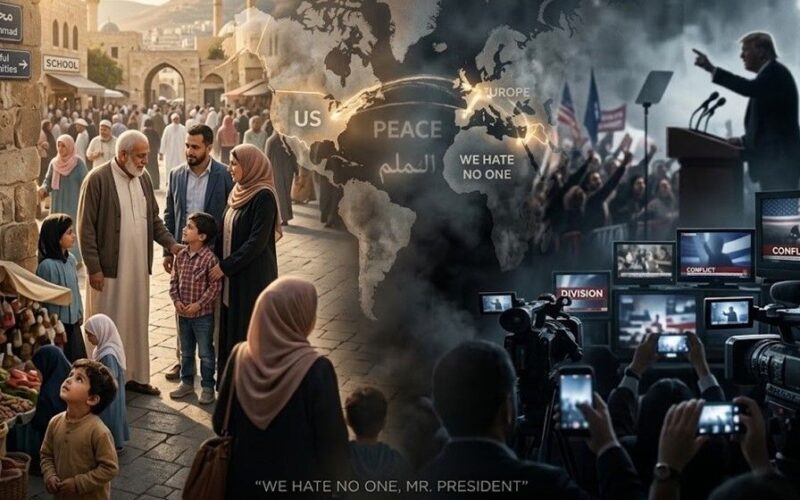
We hate no one, but you refuse to leave us in peace. That is the whole story.
Related Stories

Do you have to withdraw the social security law?

A Cabinet Reshuffle Without New Ministers