
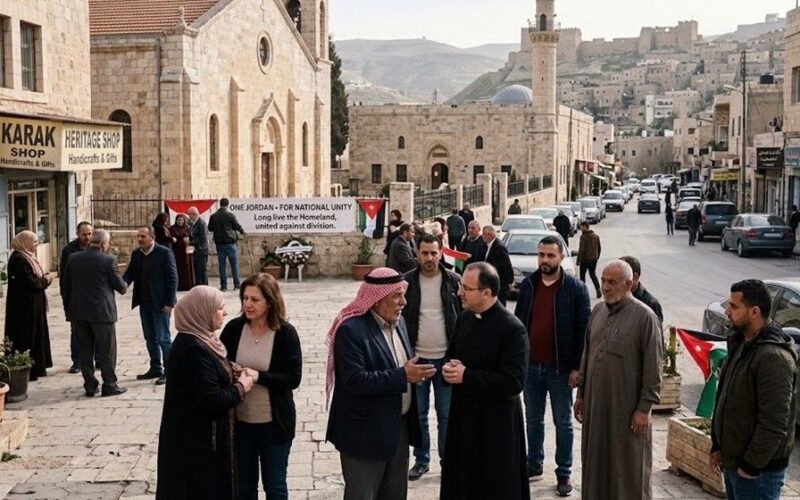
The criminal attack that took place in Karak can be interpreted from several angles. In principle, however, there is no disagreement over condemning the attack and considering it a treacherous stab in Jordan’s back before it was directed at any particular segment of its population.
These are the same currents that killed Muslims in the 2005 Amman hotel bombings and in the 2016 Karak Castle events, in which Lieutenant Colonel Saed Al-Maaytah and his colleagues were martyred. Other incidents could also be listed, in addition to the bombings targeting churches in Syria and Shiite mosques in Iraq and Pakistan.
Although the crime took place in a church, heightening sensitivities, particularly in a country such as Jordan where people of all backgrounds live together as ordinary citizens and maintain normal social relations, we must pay attention to the implications of the attack. We must ask what it seeks to provoke in Jordan amid the dangerous regional climate and efforts to redraw the region.
The timing is linked to plans aimed at undermining Jordan’s stability and drawing it into religious strife. There may also be attempts to foment discord along lines of origin and ancestry. This would mean that Jordan itself is being targeted by local groups or external actors with security links that exploit local groups. The objective is to destabilise Jordan under various slogans, paving the way to weaken and bring it down so that numerous schemes can be advanced.
The full picture will soon emerge, revealing whether the group that carried out the Karak attack was acting solely under local direction and funding, or whether it had external links. The distinction between these two possibilities is significant. If the group was exclusively local, this would require a comprehensive review of the entire issue of extremism and the mindset that departs from the essence of tolerant Islam, producing behaviour that permits the killing of Christians just as it previously permitted the killing of Muslims. It would also require examining the solutions that should be pursued.
If the group had external links, the issue would expand to include the resurgence of extremist organisations in the region, the revival of ISIS and other groups, the security vacuum in Syria and Iraq, the possibility of similar attacks occurring elsewhere in the coming period, and the ability of these organisations to recruit Jordanians or people of other nationalities. This possibility is more dangerous than the first because it also raises the prospect of intelligence agencies in the region infiltrating these organisations and pushing them to carry out attacks under appealing slogans, even as those attacks ultimately serve other agendas. This is happening at a time when the security environment across the region can be described as fragile.
More troubling still, the spread of hatred is not driven solely by some ignorant individuals inside Jordan. Its main sources include thousands of social media pages and websites operating from outside the country. Those who argue that the issue is simply a matter of attitudes cultivated among certain people inside Jordan fail to recognise that the forces fuelling such sentiments flow across borders through the internet. Combating extremism and hatred therefore requires a joint Jordanian, Arab and international effort.
Christians in Jordan do not need anyone to certify their good conduct. Above all, they are citizens who deserve respect alongside all other Jordanians. The public reaction to the crime, which came as a profound shock, is clear evidence of this.
The essential task following this attack is to remain alert to the possibility that various parties may once again seek to provoke crises within Jordan on religious grounds, along lines of origin and ancestry, or for any other reason. Everyone understands that Israel’s plans cannot gain a foothold in Jordan without internal groundwork involving the spread of chaos.
Some people do not want to identify the party that stands to benefit from these treacherous incidents and prefer to confine the discussion to their local causes. They are, of course, entitled to their views. Ultimately, however, we must not omit the name of the party that benefits from the events from our discussions. It benefits in every scenario, whether it is directly responsible for the attacks or merely exploits them to advance its agenda, in a region whose foundations are crumbling day by day under the weight of successive crises.
What greater gift could the European and American right use in its campaigns against Muslims than a crime of this kind, committed in a country distinguished by the absence of religious persecution or the targeting of its citizens on religious grounds?
Jordanians, Muslims and Christians alike, are reasonable people and will not allow discord to be fomented on any basis.
Related Stories

Isolating Iran: The Most Dangerous File at the G20 Summit
Who Remembers October 7?