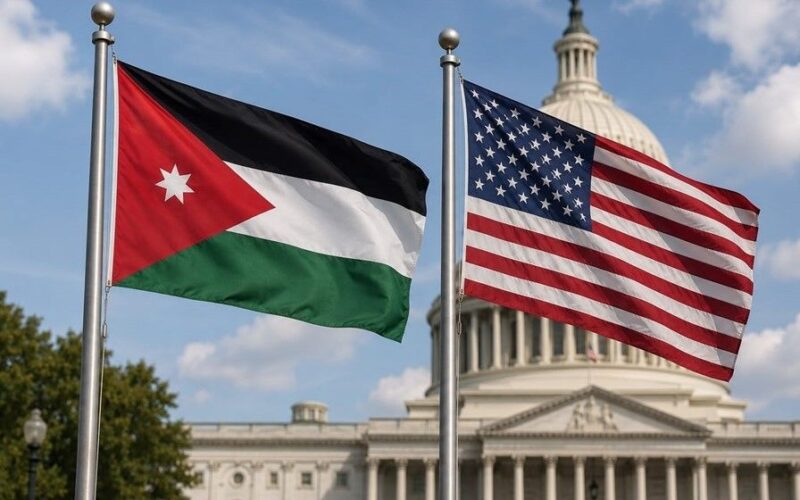
Just over a year after Prime Minister Jaafar Hassan’s economically focused visit to Washington, the Jordanian government, represented by Minister of Industry, Trade and Supply Yarub Qudah, signed what can be described as one of its most successful economic agreements with Jordan’s most important strategic partner: the United States.
The newly signed Reciprocal Trade Agreement grants Jordan some of the most favorable trade terms compared with other Arab countries and many nations worldwide.
Jordanian exports to the U.S. will be subject to tariffs of no more than 10%, while textiles and garments which account for the largest share of Jordan’s exports will continue to enjoy zero tariffs.
The figures underscore the importance of the U.S. market to Jordanian industry. During the first four months of this year alone, Jordan exported goods worth JD 595 million to the United States, with the bulk coming from key sectors including apparel and textiles, jewelry, machinery, electrical equipment, and pharmaceutical inputs.
Negotiations between Washington and its trading partners over the tariff policies adopted by the Trump administration were far from easy. Major disputes emerged with key economic partners in Europe, Canada, South America, Japan, and China, creating significant disruptions across global markets.
From the outset, Jordan adopted a calm and pragmatic negotiating approach, seeking the best possible agreement despite Washington’s firm stance, without relying on the historical strategic alliance between the two countries as leverage.
Before Prime Minister Hassan’s visit to Washington in April 2025, King Abdullah II had already laid the groundwork through his own visit. This paved the way for successful negotiations by Jordan’s economic team with their U.S. counterparts.
The resulting agreement achieves Washington’s objectives while securing additional gains for Jordan without compromising its economic interests.
It provides Jordanian exports with broader access to the U.S. market, creates favorable conditions for expanding production capacity, generates more employment opportunities for Jordanians, attracts new investments, and strengthens the country’s competitiveness against other exporters serving the American market.
The new agreement also builds on the Jordan–U.S. Free Trade Agreement, signed nearly a quarter of a century ago, which was among King Abdullah II’s earliest economic achievements after assuming his constitutional powers.
What makes this latest agreement particularly noteworthy is that it was concluded at a time when the political positions of Jordan and the United States are not fully aligned.
Differences over the management of regional conflicts have become increasingly visible, especially regarding the policies of Israeli Prime Minister Benjamin Netanyahu’s government.
The current U.S. administration’s regional policies have created considerable challenges for Arab allies, including Jordan. Less than two years ago, Jordan faced a potential crisis following President Trump’s proposal to relocate Gaza’s population to Egypt and Jordan. Jordan handled the issue with prudence, working alongside Arab partners to redirect diplomatic efforts toward achieving a ceasefire.
Shortly afterward, a new regional conflict involving Iran imposed, and continues to impose, significant costs on many Arab states.
Despite these developments and the resulting pressures on bilateral relations, Jordan has succeeded in avoiding a deterioration in ties with Washington.
Instead, it has maintained its unique bilateral relationship while further strengthening cooperation in the economic, military, and security fields.
This strategic partnership remains too important to sacrifice, regardless of political disagreements.
International agreements rarely come without a price. Yet in this case, Jordan appears to have secured the best possible deal available.
Related Stories
Do economic sanctions bring victory for Trump?

Real Accountability Starts With the Government's Program