
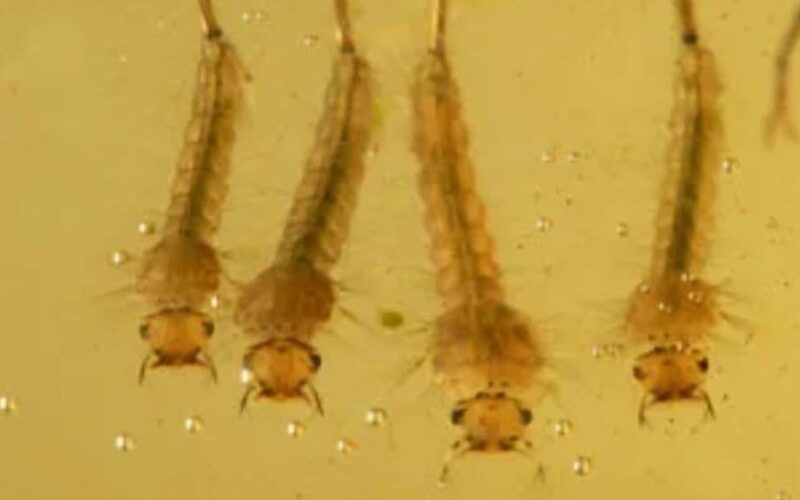
The discovery of fossil insect larvae preserved in Jordanian gypsum has revealed an intriguing observation that may contribute to our understanding of insect evolution during the Cretaceous Period, approximately 100 million years ago.
Among the fossil specimens I examined, one larva displays a tube-like structure located near the head region. This structure appears different from the respiratory siphon seen in modern mosquito larvae, where the siphon is positioned at the posterior end of the abdomen.


Today, mosquito larvae typically hang just below the water surface with their heads directed downward while breathing through a posterior siphon that reaches the air. In contrast, the fossil specimen seems to preserve a tube-like projection in the anterior part of the body. If this interpretation is confirmed through further study, it may represent an important difference in larval morphology between ancient and modern forms.
The comparison between the fossil specimen and living mosquito larvae raises an interesting scientific question: Did the position of the respiratory siphon change during the evolutionary history of mosquito-like insects, or does the fossil represent a different lineage with a distinct respiratory adaptation?
At present, this observation should be regarded as a scientific hypothesis requiring additional evidence. More fossil specimens, detailed microscopic examination, and comparisons by specialists in fossil insects will be necessary before firm conclusions can be reached.
The gypsum deposits of Jordan continue to provide remarkable fossil discoveries that deserve careful investigation. These fossils may preserve valuable information about ancient freshwater ecosystems and the evolutionary history of insects during the Cretaceous.
The continued study of these exceptional fossils may help reveal previously unknown aspects of insect evolution and further demonstrate the scientific importance of Jordan’s fossil heritage.
The first picture is a respiratory tube near the head region, and the second picture is respiratory siphon in modern mosquito larvae located at the posterior end of the abdomen.
Related Stories

Inflation: A New Test of the Economy’s Resilience

Trump Backs Down… Will Diplomacy Move Forward?