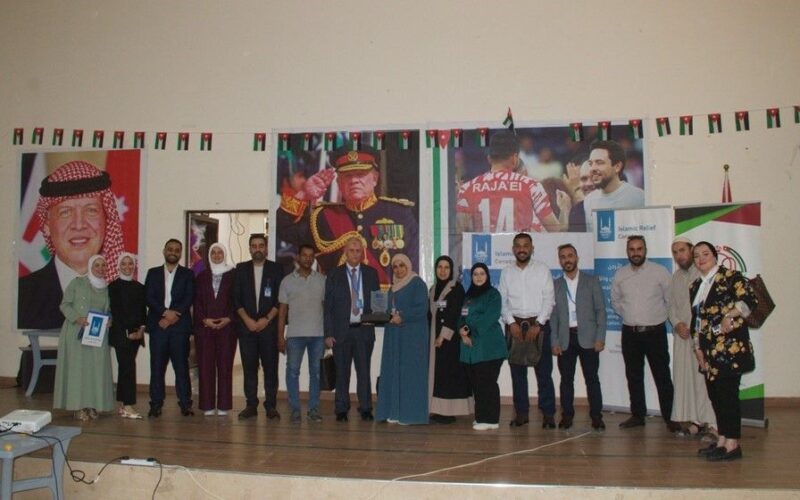
Today, a graduation ceremony was held for the “Youth Soar” project, implemented by Islamic Relief Worldwide – Jordan Office, and funded by Islamic Relief Canada. The event was attended by the Vice President of the Dulail Municipality, His Excellency Eng. Firas Abdul-Rabbah; the Director of the National Aid Fund –


 Branch, Iman Abu Dhiab; Lina Al-Dawoud, Director of the Projects Department at the Hashemite Charity Organization; and representatives from the Iksab Center for Development and Growth.
The project aims to support Syrian refugees and host Jordanian communities, promote access to a safe and equitable learning environment, and improve opportunities for economic participation and self-reliance for the most vulnerable groups.
Under the project, 103 women were provided with small grants in the livestock sector. Each right holder received three heads of goats, along with feed troughs, fodder, and waterers, ensuring a practical and safe start for their projects. This helps women manage their productive enterprises in a manner consistent with their family and social circumstances.
A total of 103 women benefited from the project’s interventions, which included specialized training in financial management, entrepreneurship, economic feasibility studies, marketing, and livestock breeding and care. Beneficiaries also received micro-grants to launch their own enterprises; these grants included the distribution of 309 heads of livestock alongside the necessary supplies for project execution. The project will continue to provide home visits and consultations to beneficiaries to monitor their enterprises and enhance their sustainability.
During the ceremony, the Dulail Municipality was honored with a commemorative shield in appreciation of its fruitful efforts and cooperation with Islamic Relief in implementing the project. Thanks were also extended to local associations that contributed to conducting the training, led by the Iksab Center for Development and Growth.
In his speech, Engineer Abdelrahim Shawahneh, Country Director of Islamic Relief Worldwide in Jordan, stressed the importance of partnership with government and local institutions for the success of such projects. He noted that Islamic Relief is committed to supporting economic empowerment initiatives that contribute to improving the lives of the most in-need families and enhancing their self-reliance. He added that this project embodies a living model of role integration among official authorities, humanitarian organizations, and the local community. He also presented an overview of Islamic Relief’s various projects in Jordan.
For her part, Iman Abu Dhiab, Head of the National Aid Fund – Zarqa Branch, stated: “Many thanks to Islamic Relief for their fruitful efforts in delivering this type of project, which has a clear impact in transitioning families from aid recipients to self-reliant households.”
The project encompassed a range of integrated interventions, including enhancing the educational environment by rehabilitation of ten schools, building three play areas, and distributing 3,500 school bags containing supplies and stationery.
Moreover, it included delivering youth training in work readiness, English language skills, and technical areas such as Arduino and robotics. It also supported entrepreneurship and business development skills, alongside capacity building for several local associations.
In its livelihoods component, the project initially focused on the Zarqa and Karak Governorates before developing a tailored intervention better suited to the needs of the local community in the Dulail district. This tailored phase focused on women’s economic empowerment through specialized training and productive kits.
The project idea originated in response to local needs. The Islamic Relief team conducted a participatory field assessment involving interviews with official and local entities—including the Ministry of Social Development, the National Aid Fund, the Governorate Development Unit, the Dulail Municipality, and local associations—as well as focus group discussions with local community members in the Zarqa Governorate and the Dulail district.
Assessment findings revealed that women in the area face genuine economic challenges, notably limited employment opportunities, low income, difficulty accessing markets and services, and a lack of financing and specialized training options. The assessment also indicated that the interventions best suited to the local context are those combining practical knowledge with productive support, aligning with the nature of the region and the social conditions of the families.
It is worth noting that Islamic Relief Worldwide was established in 1984 by a group of university students in the United Kingdom, with the sole objective of alleviating the suffering of the most vulnerable and providing aid and relief to people around the world. No one at the time could have envisioned that this local charity would transform into one of the world’s largest humanitarian relief and development organizations, committed to saving and improving vulnerable lives. Its humanitarian and development projects currently support over 10 million people annually, directly contributing to the Sustainable Development Goals (SDGs).
Islamic Relief began its operations in Jordan in 1997 through its orphan sponsorship sector and was officially registered in 2012. Today, it operates across various regions of Jordan, reaching nearly two million beneficiaries.
In addition to the livelihoods sector, the organization operates in several other domains—including orphan support, seasonal projects such as Qurbani and Ramadan food parcels, healthcare, education, school and home rehabilitation, and community development. To date, its reach has extended to approximately two million families across different regions of the Kingdom.