
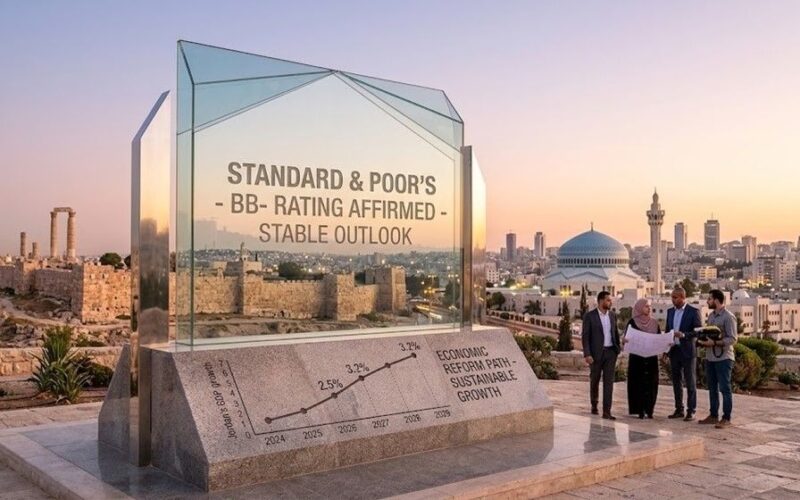
Standard & Poor’s decision to affirm Jordan’s sovereign credit rating at BB- with a stable outlook was, at this particular moment, no mere technical decision — it carries an important message of confidence in the Jordanian economy’s ability to withstand one of the region’s most turbulent environments.
The decision comes as regional economies face major pressures from geopolitical tensions and disruptions to trade, transport, energy, and supply chains — factors that weigh directly on public finances and economic activity.
The real significance of the rating lies in what it signals to markets, donors, and international institutions: that Jordan remains capable of managing its economy and maintaining fiscal and monetary stability, and that the reform path it is pursuing retains a measure of credibility and continuity.
The agency pointed to a set of factors supporting its decision, most notably the economy’s resilience, rising foreign reserves, the continuation of economic, fiscal, and monetary reforms, in addition to international support and the reform program with the International Monetary Fund.
More importantly, this rating should not be read as a final seal of approval, but rather as an added responsibility for the government to keep pursuing reform. Sustaining this confidence requires continuing to control public spending, improving the efficiency of resource use, gradually reducing the deficit and debt, broadening the productive and export base, and improving the investment environment — without slowing growth or placing additional burdens on citizens.
The significance of the decision also extends beyond Jordan itself to its relations with donors and international financial institutions. A stable rating for an economy located in a high-risk region strengthens the Kingdom’s ability to access financing, bolsters investor confidence, and helps improve future borrowing terms as fundamental indicators continue to improve.
S&P expects Jordan’s economy to grow by 2.5% in 2026, with average growth rising to around 3.2% during 2027-2029 — reflecting the possibility of the economy gradually shifting from a phase of managing shocks to one of achieving higher, more sustainable growth.
What’s needed now is to build on this confidence. The challenge is no longer just maintaining the rating, but gradually moving it to higher levels, through a more productive and competitive economy, more efficient public finances, less costly debt, and investments capable of creating jobs.
This, precisely, is the real test facing Jordan’s economic reform in the years ahead.
Related Stories

The Disarmament Scenario

West Bank on the Brink of Collapse