
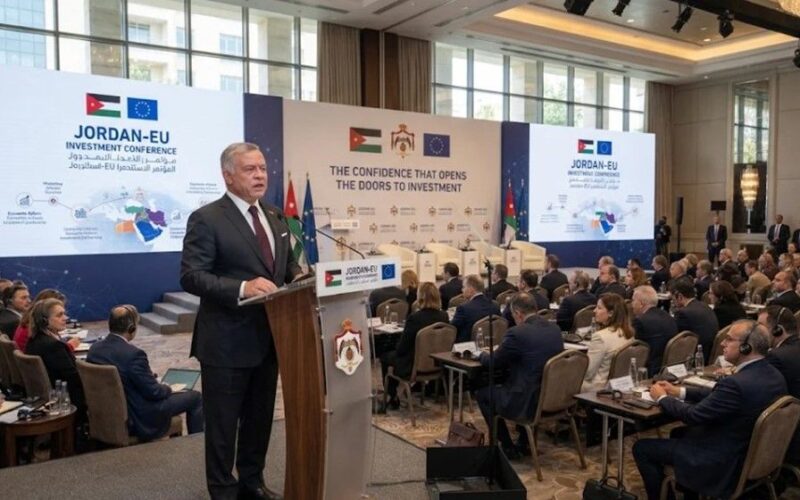
In a post on the platform X on Thursday, His Majesty King Abdullah II sent a clear message to European investors: “We are fully ready for your investments.”
The confidence carried by the message’s few words condensed years of political, economic and administrative reform, as well as long months of preparation for the Jordan-EU Investment Conference, and a determination to show that Jordan stands apart from its surroundings.
The message came from a leader who knows his people’s capabilities and understands the scale of the challenges facing his country, yet whose state has the political and security stability that qualifies it to address investors in this confident language. Jordan, which has lived for decades in a turbulent region, has shown that this location can become an economic advantage if opportunities are well used.
The Jordan-EU Investment Conference offered a practical picture of the standing Jordan wants to hold in European economic calculations, and of the kind of relationship it seeks to build with its partners. It draws on a political and diplomatic reserve accumulated over many years, and on economic and legislative reforms aimed at improving the business environment and increasing its competitiveness.
The high-level European presence reflected the level of interest Jordan enjoys, a interest whose causes go beyond good political relations to an increasing European understanding of the importance of having a stable and trustworthy partner in a region undergoing rapid security and economic change.
The conference was preceded by the signing of the Comprehensive Strategic Partnership between Jordan and the European Union in January 2025, as well as promotional tours and meetings with European companies. The preparations revealed an important shift in how investors are treated. An investor wants to know the nature of the market, the stability of legislation, the cost of production, the ability of institutions to make decisions, and the time his project needs to move from approvals to operation.
These issues were at the heart of the royal speech to the conference, when His Majesty pointed to the advanced investment legislation Jordan offers, the simplified administrative procedures and the competitive incentives. That message carries in its substance a commitment that state institutions will be partners in making investment succeed, and that they will treat the investor as a party contributing to the growth of the economy and the creation of jobs.
It is important to view what has been achieved in a wider context than the results of a single day. The agreements and memoranda of understanding have established channels of co-operation that will need follow-up. Meanwhile, the move towards negotiating an agreement to facilitate sustainable investment between Jordan and the European Union offers an opportunity to improve procedures and ease the obstacles facing investors.
The conference was able to present Jordan as a safe and trustworthy investment destination, and to offer the stability it enjoys as an economic asset that can be put to use. Investment seeks an environment in which it can plan for years ahead, away from political and legislative surprises. This is what gives the Kingdom an advantage in a neighbourhood where risks remain high.
This advantage, however, needs continuous support through administrative efficiency and speed of delivery. There is a difference between the state succeeding in attracting investors’ interest, and its ability to retain them and turn their interest into productive projects. The responsibility of the government and the private sector is therefore doubled after the conference, especially in providing infrastructure and training the skills that new projects need.
One of the most important gains of the conference is the strengthening of Jordan’s place in European economic thinking, as a partner that can be relied upon to build long-term relations, and as a possible base for expansion into the region’s markets.
The King played a central role in reaching this stage, through building strong international relations and using the political trust the Kingdom enjoys to open new avenues of economic co-operation. The conference gave these efforts an executive framework, and placed Jordan’s institutions before the test of their ability to make the most of the opportunity.
Related Stories

A New Chapter in Relations Between Amman and Baghdad
Awaiting Additional Waves of Global Inflation