
Jordanian amber continues to reveal remarkable evidence of ancient plant life, offering a rare window into the vegetation and reproductive processes of the Early Cretaceous period, approximately 140 million years ago.
Among the most interesting discoveries in my examination of Jordanian amber are fossilized pollen grains displaying different forms and structures. These microscopic inclusions provide valuable information about ancient plants and their possible reproductive mechanisms.


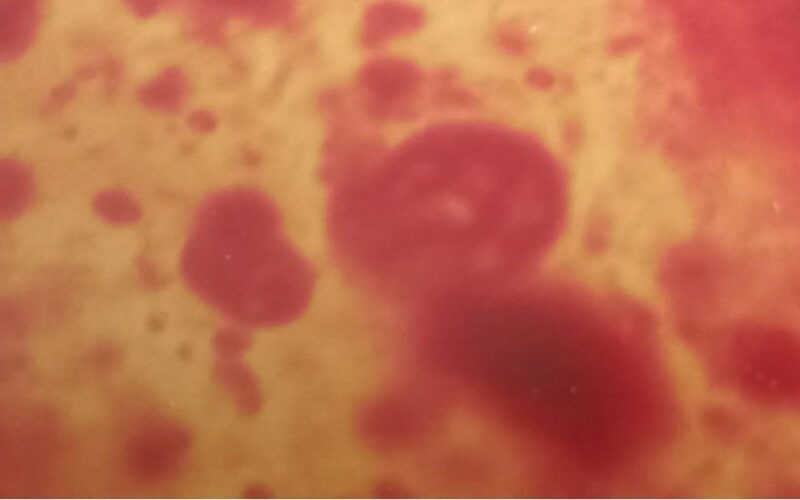
Three particularly interesting images illustrate these observations.
1. Perforated Pollen Grains: The first image shows pollen grains with visible holes extending through their structures. These perforations are particularly interesting because they differ from the normal surface appearance of the other pollen grains examined. Their origin and biological significance require further microscopic investigation.
2. Normal Pollen Grains: The second image shows ordinary pollen grains, providing a comparison with the perforated specimens. The differences between these forms raise important questions about pollen structure, preservation, and the diversity of ancient plants.
3. A Pollen Tube Associated with a Flower Ovule: The third image is especially significant. It shows a pollen grain with a tube-like structure extending toward and appearing to enter a flower ovule.
This observation may represent evidence of an ancient stage in the pollination and fertilization process. If confirmed through further examination, it could provide valuable insight into plant reproductive biology during the Early Cretaceous.
The preservation of pollen grains, perforated structures, and a possible pollen tube associated with an ovule in Jordanian amber offers an unusual opportunity to investigate the reproductive biology of ancient plants.
These findings demonstrate that amber is not merely a record of ancient insects. It can also preserve delicate botanical structures that help us understand the evolution and reproduction of plants millions of years ago.
Further detailed microscopic examination and scientific comparison will be necessary to establish the precise nature and significance of these structures.
Jordanian amber continues to reveal secrets of an ancient forest and provides an important archive of life from approximately 140 million years ago.
Related Stories

We've Had Enough of This Nonsense

The MP's Question and the Missing Answer