
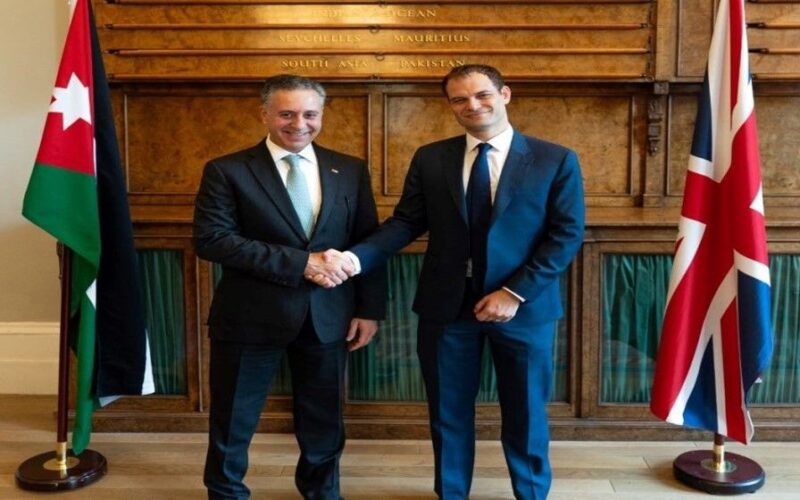
Jordan’s Minister of Industry, Trade and Supply, Yarub Qudah, and the UK’s Parliamentary Under-Secretary of State for the Middle East, Hamish Falconer, co-chaired the second meeting of the Jordan–UK Partnership Council in London to discuss expanding economic, trade, and investment cooperation and review progress under the bilateral partnership agreement.
During the meeting, held at the UK Foreign, Commonwealth & Development Office, both sides reaffirmed the strength of the long-standing strategic relationship between Jordan and the United Kingdom, describing their partnership as entering its second century as a model of sustainable economic cooperation.
The council reviewed bilateral trade indicators, which showed Jordanian exports to the UK rising by 88% during the first four months of the year, reaching $37.2 million, up from $19.8 million during the same period last year. Jordanian imports from the UK declined by 17% to $115.2 million, reducing the trade deficit to $78.1 million.
Qudah said the meeting reflected the resilience of the economic partnership between the two countries and their shared commitment to strengthening cooperation in line with evolving economic conditions.
He stressed that Jordan continues to implement its Economic Modernization Vision while fostering a competitive investment environment. He noted that Jordan’s proposals to simplify rules of origin aim to expand the benefits available to domestic industries, increase exports, create jobs, and attract high-quality investments.
Qudah also emphasized that Jordan has the potential to become a regional hub for industry, logistics, and reconstruction, thanks to its stability, advanced infrastructure, and investment incentives.
He encouraged British companies to explore investment opportunities across various sectors in the Kingdom.
During the meeting, Jordan proposed extending the simplified rules of origin arrangement under the partnership agreement for an additional 15 years beyond 2030, removing the requirement to employ Syrian workers within manufacturing facilities, and expanding product coverage to include processed agricultural and food products.
The two sides agreed to establish a joint technical committee that will work over the next three months to develop practical solutions.
The council also approved recommendations to restructure the agreement’s governance by replacing four subcommittees with a streamlined framework consisting of the ministerial-level Partnership Council and a unified Partnership Committee to oversee technical matters and accelerate implementation.
Qudah welcomed British support for Jordan’s services trade development project, implemented through the UK Trade Partnerships Programme in cooperation with the International Trade Centre.
The initiative aims to prepare studies and a roadmap for developing Jordan’s services sector and related regulatory policies, with particular emphasis on engineering and education services.
The Jordanian delegation highlighted key initiatives under the Economic Modernization Vision, including the country’s industrial policy to enhance competitiveness in high-value sectors, reduce production costs, promote innovation, and support the transition to a green economy.
Officials also outlined the National Export Strategy and the role of the Industry Support Fund in boosting productivity and creating employment opportunities.
Both sides praised the successful export activities of Jordan Phosphate Mines Company and Arab Potash Company to the UK market, describing them as success stories that could encourage more Jordanian businesses to enter the British market and establish commercial partnerships.
For his part, Falconer reaffirmed the UK’s commitment to deepening its economic partnership with Jordan and building on the progress achieved under the bilateral agreement.
He described Jordan as a trusted strategic partner with a promising business environment and expressed Britain’s interest in expanding cooperation in trade, investment, and services to support economic growth and create new opportunities for businesses in both countries.
Falconer also pledged continued UK support for initiatives aimed at developing trade, sharing expertise, and strengthening institutional cooperation.
The Jordanian delegation further presented Jordan’s advantages as a logistics hub for regional reconstruction efforts, highlighting the allocation of a 900-dunum free zone in Mafraq Governorate and the Mafraq Dry Port project, which are expected to provide British companies with investment opportunities in construction, engineering services, and logistics through customs and tax incentives.
Both sides agreed to address challenges affecting bilateral trade by pursuing practical solutions that ensure the smooth flow of commerce.
The meeting also focused on strengthening private-sector engagement through the activation of the Joint Jordanian-British Business Council, increasing business delegations, and encouraging British companies to participate in the Jordan–UK Business Forum scheduled to take place in London later this month.
British officials expressed their readiness to support the forum and facilitate new investment opportunities and business partnerships between companies from both countries.
The meeting was attended by senior officials, technical experts, and diplomatic representatives from Jordan and the United Kingdom.