
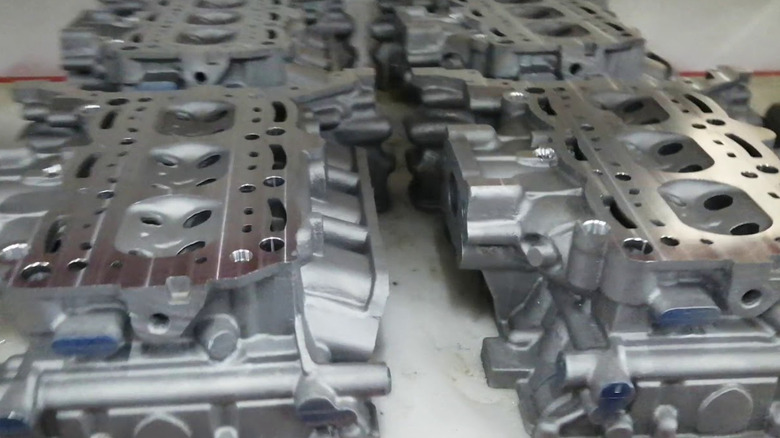
How Long Can A 3D-Printed Cylinder Head Last On A Running Engine?
3D printing, though still somewhat of a niche hobby, is growing in popularity. Much of that is thanks to its adoption in various industries. That includes the automotive world, as there are 3D-printed car accessories that are actually useful. But printing car parts, like a 3D-printed cylinder head, is a more complex process.
A 3D-printed metal cylinder head doesn’t have a set lifespan because it technically can’t. That’s because it can fail the same way a factory head can: through continuous heating and cooling over time. That’s regardless of whether the cylinder head was 3D printed or built using conventional means.
So essentially, a cylinder head’s life really comes down to how many times it can handle the stress of heating up and cooling down before it cracks. That lifespan depends more on how often the engine goes through these heat cycles rather than how many miles you drive. Either way, the exact lifespan is tough to predict.
This is also known as Thermo-mechanical fatigue (TMF)
TMF describes a failure mechanism in which a 3D-printed cylinder head, or any cylinder head for that matter, can sustain damage from repeated heating and cooling over time. So regardless of how the head is manufactured, the material still expands and contracts with heat. Because of this thermal cycling under load, the head can still experience TMF.
3D printing limits inside engine design
A 3D printer, which can save you money on some things, would typically use metal as the preferred material for printing a cylinder head. However, both polymer and metal are regularly used to print parts that aren’t directly subjected to the intense heat of the engine. For example, 3D printing is widely used in the automotive industry for a variety of components, including air ducts, brackets, fixtures, and more. That’s where the ability to shape parts and produce them quickly matters more than extreme thermal resistance. But that doesn’t mean that 3D printing can’t be used in engine development. In fact, if you had $20K and a 3D printer, you could build your own Lamborghini.
Components like pistons, intake manifolds, and even turbocharger parts, are now being produced by manufacturers using 3D printing. This allows engineers to add such features as internal cooling channels, which wouldn’t be easy to do in traditional manufacturing. In some cases, several parts can be grouped together into a single piece, which results in more simplistic part, while also saving assembly time.