
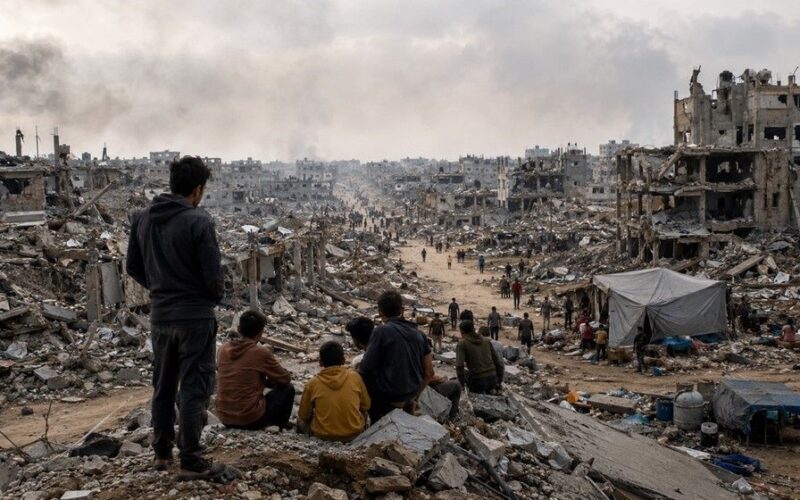
Amid the ongoing U.S.–Iran confrontation in the region, Gaza has emerged as one of the most urgent issues that continues to be overlooked or marginalized. This is largely because reaching a memorandum of understanding, despite its complexity, appears easier than addressing the plight of Gaza’s population, who continue to endure relentless bombardment day and night with inadequate protection and insufficient humanitarian assistance. Israel continues to conduct airstrikes, artillery shelling, and demolition operations across different parts of the Gaza Strip. It has also expanded its military control to approximately 70 percent of the territory, confining Palestinians to a narrow area representing no more than 30 percent of the Strip. Although the Palestinian factions have adhered to the ceasefire, Israel has not, and continues to carry out daily military operations against Palestinians without facing any meaningful consequences or sanctions for these violations.
The International Stabilization Force, established by the Peace Council appointed by President Trump, arrived in Israel on 16 June and is expected to enter the Gaza Strip through the Kerem Abu Salem crossing. According to the U.S. peace plan, the Stabilization Force constitutes one of four institutional components envisaged in the framework for ending the war in Gaza, which was subsequently endorsed by the United Nations Security Council through Resolution 2803, adopted on 17 November 2025. Five countries have pledged to contribute troops to the multinational security force, while Jordan and Egypt have committed to training members of the Palestinian police. Ironically, the force’s principal objective may also represent its greatest challenge. Under the Trump plan, its primary mission is to disarm the Palestinian factions, dismantle military infrastructure, protect civilians, and secure humanitarian corridors.
The deployment of the Stabilization Force represents the second phase of the peace plan, following the implementation of the first phase on 10 October 2025. The second phase envisages a broader withdrawal of Israeli forces from the Gaza Strip. However, developments on the ground sharply contradict these provisions, as Israeli forces continue expanding their military presence and territorial control within Gaza.
The upcoming Israeli elections are casting a significant shadow over the future of Gaza. Many Israeli voters consider resolving the Gaza issue a decisive factor in determining their electoral choices. Furthermore, linking the disarmament of Hamas and other Palestinian factions to the reconstruction of Gaza has further compounded the suffering of the population. Although reports and official statements indicate that the Peace Council intends to proceed with reconstruction efforts in areas under Israeli military control without making reconstruction conditional upon Hamas’s disarmament, Prime Minister Benjamin Netanyahu has publicly declared that no reconstruction of Gaza will take place before Hamas is fully disarmed. This position stands in considerable contrast to the arrangements envisaged under the second phase of President Trump’s peace initiative.
Placing obstacles in the way of implementing these arrangements appears to be one of Netanyahu’s political strategies to improve his electoral prospects, particularly following setbacks in other regional arenas, including Lebanon and Iran. In the eyes of his supporters, portraying Hamas as a persistent security threat capable of regrouping and launching future attacks against Israel remains one of the few political narratives available to him. In practical terms, however, the security threat emanating from Gaza’s various armed factions has been substantially diminished. Israel currently controls most of the Gaza Strip and maintains dominance over its border crossings, airspace, maritime access, and surrounding territory. Moreover, the extensive destruction inflicted upon Hamas’s military infrastructure, as well as that of other Palestinian resistance groups, has significantly reduced their operational capabilities.
This continued Israeli reluctance to permit the reconstruction of Gaza—even in areas regarded as secure and under Israeli military control—suggests that Netanyahu is unwilling to approach the upcoming Israeli elections in October with any development that could be perceived as a political achievement for the Palestinians or that might remind Israeli voters of his government’s failure to accomplish its declared objective of completely eliminating Hamas.
Dr Emad Al-hammadin
Strategic Studies-Jordan University
Related Stories

So Democracy Does Not Become a Burden on Municipalities

We Need a Fund for Those in Financial Distress, Prime Minister