
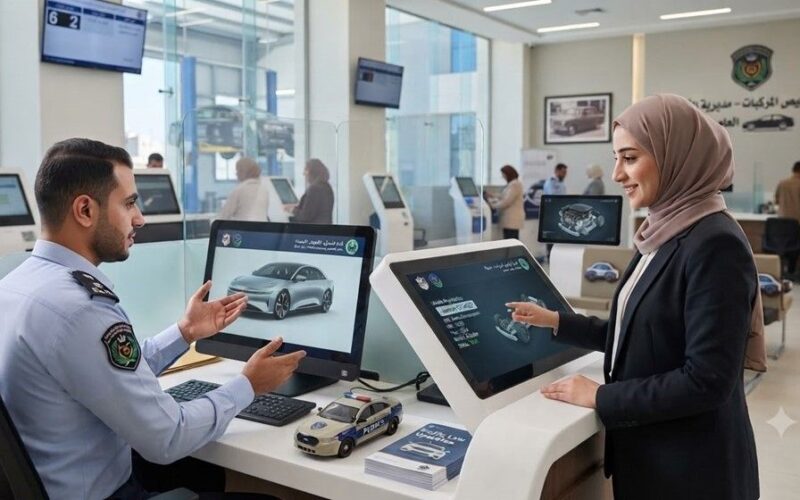
The true achievement is not simply moving a transaction from a service window to a screen. It is making paper disappear from the process altogether, allowing technology to become the only language an institution speaks.
This is precisely where the Driver and Vehicle Licensing Department of the Public Security Directorate stands not merely as a government office that has upgraded its services, but as an institution that has redefined the concept of public service from the ground up, presenting an advanced model of what government administration should look like in the 21st century.
The department has effectively won its battle against bureaucracy. Files no longer move from one office to another, transactions no longer wait for signature after signature, and citizens no longer carry documents to prove information already stored in government databases.
The era of paperwork has truly come to an end not as a slogan or a publicity campaign, but as a practical reality created by a fully integrated digital system in which data moves instead of people, information arrives before it is requested, and services are delivered through the logic of a smart institution rather than ledgers and official stamps.
The transformation led by the Licensing Department was not simply replacing paper with a digital screen it was replacing an entire organizational culture with a new one.
This change is evident across all of its service centers, even in its mobile licensing units. It is a culture built on the belief that citizens’ time is valuable, that efficiency is part of the state’s credibility, and that technology is not an administrative luxury but a tool for justice, efficiency, and transparency.
As a result, systems are fully integrated, procedures have been streamlined, and decisions are based on real-time data, making services more accurate, more secure, and better equipped to keep pace with modern developments.
If institutions are judged by what they accomplish rather than what they claim, then the Driver and Vehicle Licensing Department has provided practical proof that the Public Security Directorate excels not only in security but also in civil administration and government service delivery.
It has recognized that, in the modern era, security begins with citizens’ trust and that trust is built when people receive services that are fast, transparent, fair, and free of unnecessary complexity.
For this reason, awarding the department full marks is not flattery but an accurate reflection of what has been achieved.
Success should not be measured by the number of electronic applications an institution announces, but by its ability to complete transactions without paper, repeated visits, or wasted time for either citizens or employees.
This is precisely what the Licensing Department has accomplished, setting a benchmark by which others should be measured rather than one measured against others.
The experience created by the Driver and Vehicle Licensing Department highlights an important truth one I recently witnessed firsthand while completing a personal transaction.
When an institution has a clear vision, leadership committed to continuous improvement, and management that knows exactly what it wants to achieve, technology becomes part of the organizational culture rather than a temporary project. Excellence then becomes the natural outcome, not the exception.
At that point, government services are transformed from a burden into a public value, from a routine procedure into a modern civic experience, and from a simple transaction into a message that demonstrates the state’s ability to stay ahead of the times rather than merely keep up with them.
Related Stories

When patients pay the price for union decisions

Individual Loans: Between Asset Financing and Consumption