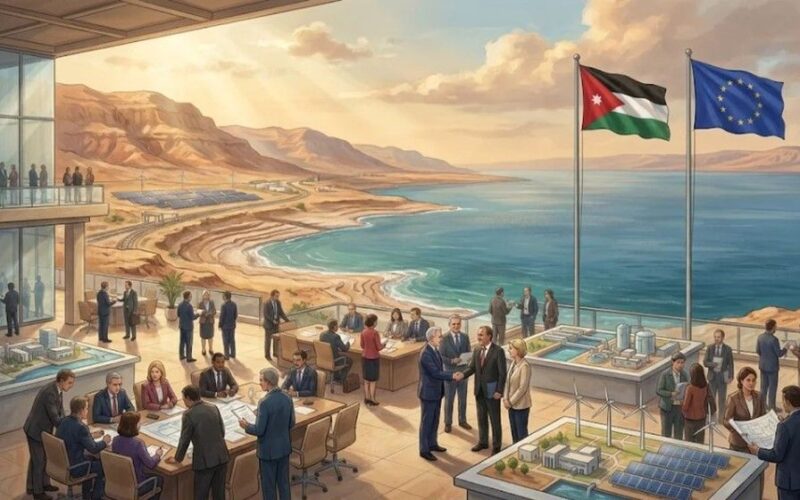
In response to a question from the Emirati newspaper The National about the Jordan-EU Investment Conference being held at the Dead Sea, the European Union’s Commissioner for the Mediterranean, Dubravka Šuica, said: “More than seventy European companies have expressed interest in investing in Jordan, and that is why we are genuinely keen to support Jordan, which is the most stable country.”
In more than one statement by European and Western officials, this phrase keeps coming up: “the most stable country in the region.”
Alongside the many advantages Jordan enjoys, stability tops the priorities of all international partners, as a prerequisite for advancing economic partnership and for any country to attract investment.
The Jordan-EU Investment Conference was due to take place months ago, but the instability in the region and the repercussions of the war on Gaza led both sides to agree to postpone it to the present day.
European partners have no doubts about Jordan’s stability as an investment and tourism destination. The recent terrorist attacks did not shake this confidence. The European Union, which condemned these terrorist acts, reaffirmed its full support for all the measures Jordan takes to safeguard its security and stability and to fight terrorist groups. Recent regional developments have also placed Jordan in the spotlight of Western attention as an alternative route for trade and shipping, after the closure of the Strait of Hormuz.
It is hard for any country in the region to win the agreement of dozens of European companies and representatives from more than fifty countries to come and hold a conference at this high level of representation and attendance. It is no secret that many countries in the Middle East have been forced in recent weeks to cancel or postpone global events they had planned to host, because of the state of war that still hangs over the region and undermines stability in many of these countries.
Jordan’s deep and firmly rooted confidence in its ability to preserve its stability despite all these challenges, and its long strategic partnership with the countries of the European Union, were the strong motivations for holding the conference on its new date.
Jordan will not forget this position from the European Union, and will hold feelings of gratitude for its continued support for our emerging economy, and for the Jordanian people’s desire to advance their country by relying on advanced partners such as the European Union.
Yet dozens of major European companies would not have decided to work with Jordan unless they were convinced that there were promising investment opportunities in key sectors such as energy, water, mining, transport and others.
Jordan enters this conference with an ambitious agenda of large packages of projects that attract European interest. Ministers and officials have already toured European capitals to present them during the preparations for the conference.
At an unprecedented historical moment, when the balance of international power and global and regional alliances is undergoing major shifts, Jordan can no longer wait for support from others. It must pursue opportunities and diversify its partnerships.
In my view, the partnership with the European Union is one of Jordan’s most stable and growing partnerships, and is no less important than our strategic partnership with the United States of America.
After this exceptional conference at the Dead Sea, the partnership between the two sides will enter a different phase, in which the European Union becomes one of the largest contributors to the economic renaissance our country is witnessing.
To reach this stage, the official bodies in Jordan, together with the private sector, must approach this opportunity with the greatest seriousness and commitment, because an opportunity does not usually come twice.
Related Stories

Victims of the “Podcast”

Which Majors Offer the Best Career Prospects?