
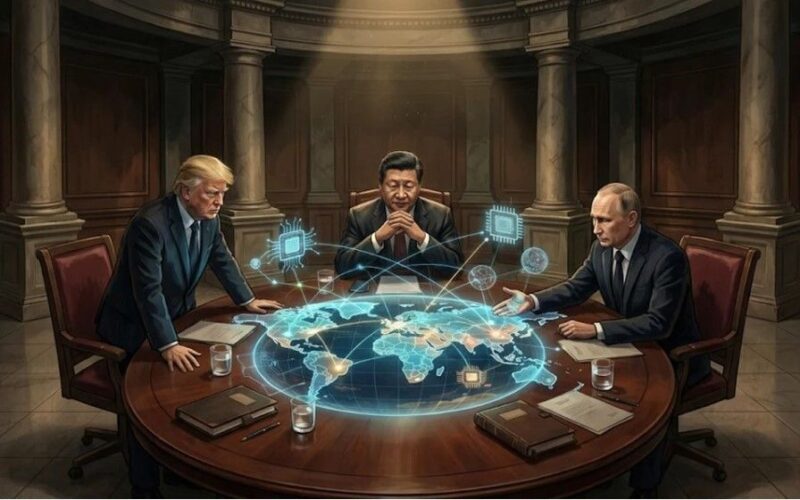
It is not easy to picture Trump, Xi Jinping and Putin sitting at the same table while their countries wage open struggles over influence, the economy and security. But international politics knows no lasting friendships, and rivalries do not prevent meetings of interests. This is why the Shenzhen summit matters. The three leaders are not travelling to China to exchange diplomatic pleasantries. Each carries files and wants to win gains from them, at a time when the Iranian war is entangled with the Ukrainian crisis, and anxiety is growing over a nuclear arms race.
Although the announced title of the summit is global peace and strategic stability, what is happening behind closed doors may be more important than the official statements. Trump wants a new nuclear agreement that includes China. Xi refuses to enter negotiations that do not take account of the large differences in nuclear arsenals. Putin, meanwhile, sees the meeting as an opportunity to bring Russia back into the circle of international decision-making after years of Western isolation.
Negotiations do not stop at nuclear weapons. The Iranian war imposes itself on the calculations of Washington, Beijing and Moscow, especially as its continuation threatens energy security and deepens instability in the region. While the United States seeks to end the confrontation on its own terms, China is watching its repercussions for its economic interests, and Russia is trying to use international shifts to strengthen its political position.
As for Ukraine, its absence from the agenda does not mean its absence from the summit’s calculations. Putin wants to improve the terms of any possible settlement of the war, while Kyiv fears that understandings between the great powers could turn into decisions about its future without its participation. These fears bring back memories of the Yalta Conference of 1945, when the major powers drew the outlines of spheres of influence in Europe after the Second World War.
In parallel, the American-Chinese rivalry over electronic chips and artificial intelligence remains present in the background of the meeting, as a contest for leadership of the economy and technology in the decades ahead.
But a meeting of the three leaders does not necessarily mean there is a joint project or an agreement to divide the world. Their interests are deeply contradictory, and what unites them today may be a desire to manage their differences rather than end them.
The important question is not what the leaders will announce after the summit, but what they may agree on away from the spotlight. Will Shenzhen be the start of understandings that prevent new conflicts from erupting, or a stage for redrawing maps of influence, where decisions are written at the table of the great powers and other countries are left to deal with the consequences?
Related Stories

Joe Hattab… an eye on Jordan