
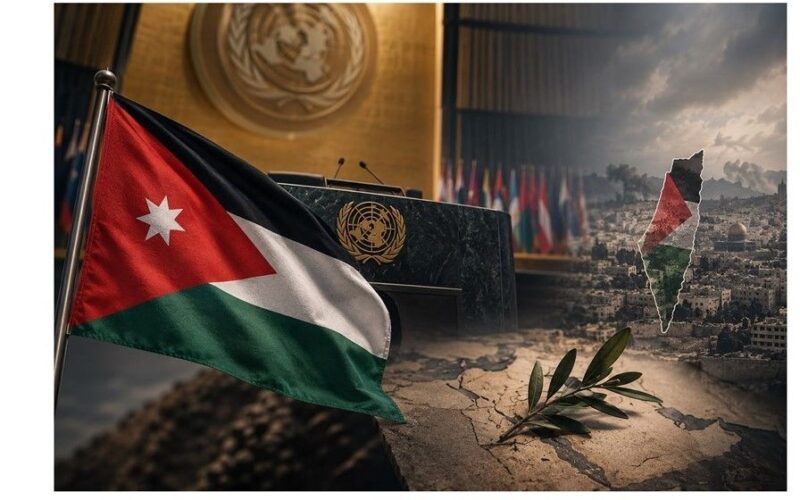
King Abdullah II’s speech at the United Nations General Assembly marked a political high point that Jordan’s position has never reached before.
In previous speeches, the King presented an accurate description of the reality of our region, the consequences of the failure to resolve the Palestinian issue fairly, and the repercussions of Israel’s aggressive policies and its rejection of the principles of a just peace.
In his speech two days ago, the King delivered an indictment of decades of international disregard for the realities imposed by the occupation and the consequences of that disregard, which have encouraged further actions aimed at creating a new reality and making the establishment of a Palestinian state impossible.
The indictment also targeted what the King described as a policy of containing the conflict rather than resolving it, reminding the world that Arab countries had presented a peace initiative endorsed by 57 Arab and Islamic states.
The speaker here is not the leader of a distant country whose agenda is filled with numerous priorities that could distract him from the world’s longest-running unresolved conflict.
Rather, he is an Arab leader whose country lies at Palestine’s closest point, a country that has pursued peace for decades, while his attention has remained firmly focused on a conflict that directly affects our national security and the future of our generations.
At its core, the speech represents a major political declaration of Jordan’s vision, drawing lessons from the profound crisis that has shaken the region over the past three years and is on the verge of bringing about major geopolitical transformations.
Jordan is preparing to deal with these changes through a strategy designed to safeguard its national security and vital interests.
The King, who has never allowed himself to be distracted from the dangers of this conflict and its implications for regional security and peace, is telling the world in unequivocal terms, without diplomatic niceties, that there is no hope for peace under a government like the current Israeli government.
He did not stop at this frank assessment. For the first time, he called on the international community to adopt a package of sanctions to deter the Netanyahu government from continuing its policies of imposing a new reality, which has increasingly emerged as an approach aimed at preventing the Palestinian people from enjoying their legitimate rights.
The King understands the balance of power and how Israel exploits the world’s inattention to advance its aggressive policies.
At the same time, he is identifying important shifts that could be built upon to change the course of international policy and reject submission to an imposed and unacceptable reality.
The successive recognitions of the Palestinian state by major countries around the world, the sanctions imposed by a major power such as Britain on settlement policies and supported by important Western countries, the harsh criticism from around the world of the conduct of what the King described as a genocidal government in Israel, and the major shifts in Western and particularly American public opinion are all developments that have not escaped the King’s attention as he presents an approach that builds on the momentum of these significant changes.
There is an opportunity here that the King is placing before the international community and major powers facing pressure from their own populations to take action and confront what the article describes as a “gang of terrorists” governing Israel, while establishing a new course that could influence the outcome of the upcoming elections there.
The King is the Arab leader with the greatest experience in the affairs of our region, whose circumstances have changed dramatically over the past two decades, while many of its leaders have disappeared amid its bitter conflicts.
Today, he bears a historic responsibility on behalf of many, understanding the scale of the risks facing our country and the Arab world, which is being torn apart by conflicts, while also recognizing the extent of the disruption in traditional alliances with the world’s superpower.
Nevertheless, in his speech he appeared, as he always has, unwilling to compromise on Jordan’s interests, its security and the lives of its people.
He did not hesitate to issue explicit warnings to anyone considering encircling Jordan from the north or imposing displacement from the west.
Related Stories

Jordan's First Blue Loan Bond Marks a New Era in Strategic Project Financing
The West Bank: A Jordanian or Palestinian Question?