Everyone wrote about His Majesty the King’s speech at the United Nations. They wrote about what he said, what he meant to say, and the political and humanitarian messages the speech conveyed to the world, as well as what lay between the lines and behind the words.
But this time, I decided to set the words aside for a moment and watch the King. I am not writing as an expert in body language, a specialist in charisma, or a professor of public speaking and communication.
On the contrary, I am writing as a Jordanian citizen who follows, reads and sometimes writes, and above all, as a Jordanian who deeply loves his King.
Perhaps that is why my eyes were drawn to different details: his appearance, presence, posture, tone of voice, choice of words, and that calmness that sometimes comes before a sentence.
I watched the movement of his hand, particularly his index finger when he wanted to emphasize a point, his gaze when he wanted to convey a meaning, and the brief pauses between one sentence and another.
These may seem like small details, but in the world of public speaking, they are anything but small. A message is not conveyed through words alone.
Sometimes it comes through the way someone stands, a look, a single hand gesture at the right moment, and sometimes, most difficult of all, through silence.
What struck me about the King was confidence a confidence that does not appear artificial and does not require raising his voice, excessive movement, or a constant attempt to prove his presence.
Some people stand in front of a camera and try to capture its attention, while others stand before it and the camera itself seems to search for them.
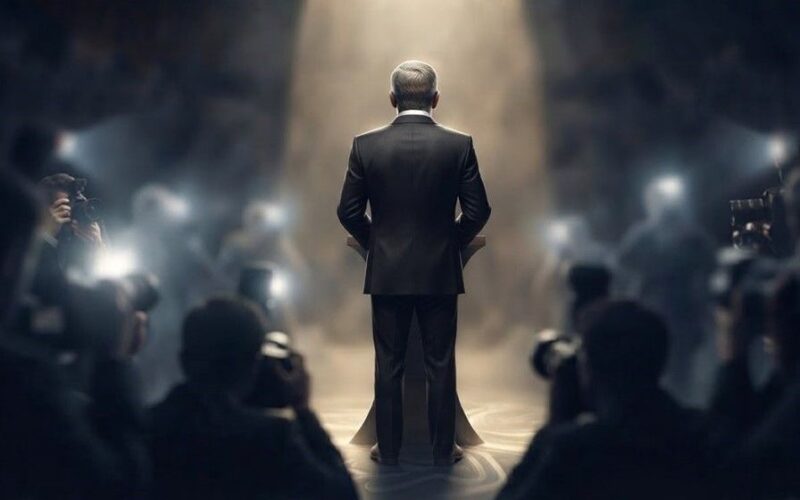
That is one of the strongest images that stayed with me: a hall filled with the world, countless faces, different languages, and cameras from every direction. Yet the eye quickly knows where to settle.
On the speaker. The King.
Not because anyone asks you to look at him, but because his presence draws you in. Perhaps this is where true charisma lies.
Charisma is not about filling a space with movement, but filling it with presence; knowing when to move your hand and when to keep it still, when to look directly ahead, when to smile, when to pause, and when to say a calm sentence and leave it to do what it needs to do.
This kind of presence cannot be created by words alone. It requires personality, self-confidence, experience, and a deep understanding of the place in which you are standing and the message you are carrying.
And when the King stands before the world, he does not appear to be searching for his place on the podium. He knows his place.
Perhaps that is why you do not feel that he is trying to create an image; the image is already there. You do not feel that he is trying to create authority; the authority is already there. And you do not feel that he is asking the camera for its attention; the camera gives it to him.
Here, the difference between spectacle and presence becomes clear.
Spectacle says: “Look at me.”
True presence says, without uttering a word: “I am here.”
I believe the most beautiful aspect of the scene was that his body language moved in harmony with the language of the speech—not ahead of it and not behind it.
The words were calm, the movements were calm, the sentence was measured, the gesture was measured, and the gaze was exactly where it needed to be.
It was as though another dialogue was taking place silently between the King, the camera, the hall and the viewer—a dialogue that needed no translator.
And that is when I began asking myself: Why, amid all this bustle, does the eye end up on him? Why, when the camera moves, do we follow it? And why, when he speaks, do we pay attention, even to the smallest details in his hands and his gaze?
A communications or body-language specialist might say there is an explanation rooted in communication theory, body language and charisma. There may indeed be dozens of studies that explain it.
But I, as a citizen, have a simpler explanation: presence is something you feel; it is not something you explain.
And when the speaker is the King of Jordan, the matter goes beyond a professional or protocol-driven scene. We do not simply see a person standing on an international podium.
We see a country standing with him. We see the image of Jordan. We see years of presence and experience in dealing with the world. And we Jordanians feel something that political analysis may never fully be able to explain.
Something called pride.
That is why I was not looking in the speech for the most quotable sentence. I was looking for the image that would remain in the memory after the words were over.
Perhaps one image will stay with me: the King of Jordan standing firmly, speaking calmly, moving his hand at the right moment, looking with confidence, while the cameras move toward him.
And the rest of the world… watches.
I may not be an expert in body language, but I know another language: the language of a citizen when he sees his country’s King standing before the world.
That is why, this time, I did not simply follow the King’s speech. I watched why the world was watching him.
And perhaps the answer was in front of me from the very beginning: because some people, when they stand before the world, need to create their presence, while others do not create presence at all they simply arrive, and in doing so, they create the space around them.
For me, that was the message that was never written in the speech: a message conveyed through his appearance, presence, confidence, gaze, hand gestures, and even the silence between his words.
Another speech… one that was not heard, but seen.
And I say it again: May God grant our King a long life.
Related Stories
Netanyahu: The Actor Who Lost His Audience But Remained on Stage

Political Messages from the South