
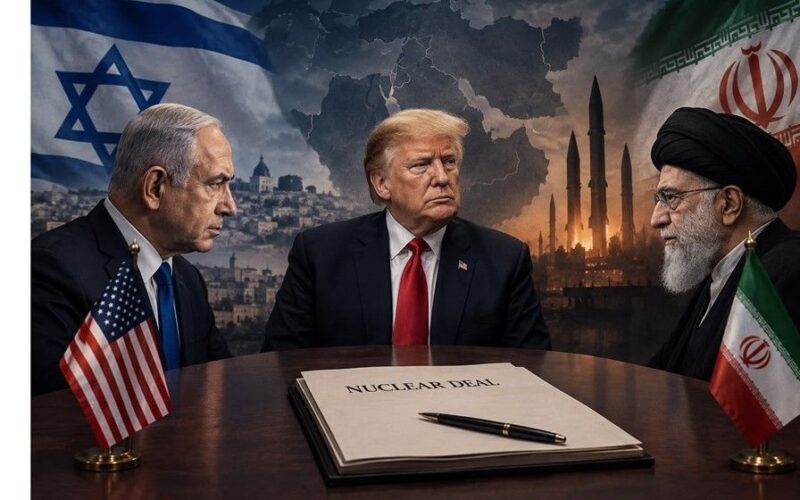
Washington and Tehran are moving closer to discussing a settlement, and concern has risen in Israel.
The reason is not difficult to understand: if a US-Iran agreement comes to fruition, it will not simply be a document ending a war or regulating Iran’s nuclear program. It could become a turning point in the balance of power in the Middle East. US President Donald Trump says that contacts with Tehran are ongoing and that he expects a settlement to be reached, while at the same time reiterating that Washington will not allow Iran to acquire a nuclear weapon.
In my view, Israel’s problem is not with the principle of negotiations itself. Israel does not view the nuclear issue as the only threat; rather, it links it to Iran’s missile capabilities, regional influence, and ability to rebuild its strength after the war.
For this reason, any agreement that focuses solely on enrichment and nuclear facilities could be seen by Tel Aviv as a temporary settlement that postpones the problem rather than resolving it.
This is where the real battle begins: pressure on Washington to broaden the negotiating agenda.
The more missiles, sanctions, military capabilities and regional influence are incorporated into the agreement, the greater the concessions Iran would have to make, and the more complicated it would become to reach a final settlement.
Israel, however, does not necessarily need to directly derail the negotiations. A potentially more effective approach could be to make the agreement Washington wants appear insufficient from Israel’s perspective.
If it cannot prevent the agreement, it can pressure Washington to change its terms. If it fails to change the terms, it can take a stricter approach to interpreting any potential violation of the agreement.
This is where the most dangerous point lies. The Middle East does not exist solely at the negotiating table; it also lives amid missiles, military operations and reciprocal responses.
The experience of June demonstrated that escalation in Lebanon was capable of complicating US efforts to end the war and open a negotiating track with Iran.
Therefore, any new incident could become a test for the agreement. An attack by a party linked to Iran, an Israeli strike against an Iranian target or an ally of Tehran, or a dispute over a nuclear facility could open the door to mutual accusations of violating the understanding.
At that point, the agreement itself would become a battleground rather than a tool for ending the conflict.
Nevertheless, Israel’s ability to impose its vision is not unlimited. Trump himself has shown in recent months a willingness to pressure Netanyahu when he believed that Israeli operations could threaten the US track with Iran.
Public tensions have also emerged between the two men over how the war and negotiations should be managed.
For this reason, the next battle will not simply be between Israel and the agreement. Rather, it will be a struggle over the agreement’s substance, the limits of its implementation, and who has the authority to interpret it.
Iran wants an agreement that ends the war, eases pressure and gives it an opportunity to rebuild its strength.
Israel wants guarantees preventing Tehran from using that opportunity to restore its capabilities. Trump, meanwhile, wants an agreement that he can present as a US achievement while keeping the Iranian nuclear threat under control.
Yet, in my view, the real question is this: Can Israel prevent an agreement that does not fit its vision of regional security, or will it have to coexist with an agreement that it seeks to reshape from the very beginning?
The greatest danger facing any settlement is not simply that it will be rejected before it is signed, but that it will be signed and then see the parties begin testing its limits until it loses its ability to endure.
Related Stories
On a Cabinet Reshuffle Without a Reason

Distributing the Cost of War