
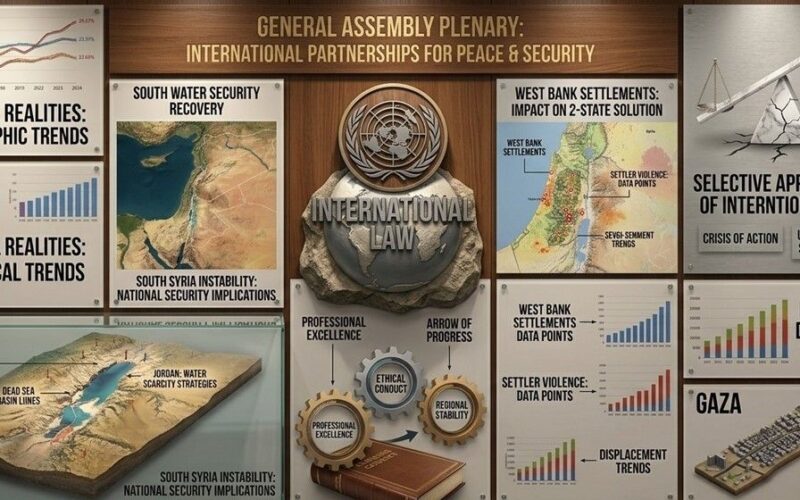
In a quick comparison between His Majesty the King’s previous speeches at the United Nations and his address yesterday, the raised ceiling of political language becomes clear, along with a shift from warning of consequences to describing what Jordan sees as already-existing realities, tied directly to Jordanian national security.
The King framed his speech within an intellectual framework that could be called “the crisis of international attention,” to explain the problem of an international system that pays attention to a crisis when it explodes, then moves on to another crisis, while the causes of the first remain unaddressed. The speech then moves from describing the attention crisis to a second problem he identified: a lack of action.
The King says, quite clearly, that the world knows of many crises, and has watched their preludes and developments, but hasn’t moved effectively to prevent them from turning into more dangerous realities.
The Palestinian cause is the clearest example of this predicament. For many long years, Jordan’s addresses before the United Nations have not been free of warnings about the consequences of the absence of a political solution, just as the King has repeatedly warned against expanding settlement activity, continued occupation, and the diminishing chances of a two-state solution.These warnings stemmed from reading trajectories that were forming and developing gradually before the eyes of the international community.
Today, the space for warning about what could happen is narrowing, while the space for discussing what has actually happened, and what is happening now, is widening, as the conversation has shifted to how to deal with a reality that has changed greatly, and realities that have accumulated over years of managing the conflict rather than resolving its root causes.
On Gaza, the speech raised the question of protection, accountability, and the effectiveness of international law, while on the West Bank it pointed to the accumulation of facts on the ground, the expansion of settlements, settler violence, displacement, and land seizure. In both cases, the core issue is the international community’s ability to prevent the imposed reality from becoming a permanent one, difficult to change later.
Perhaps it’s this trajectory of realities that raises the question of the value of international law, when it’s applied in one case and suspended in another, with international institutions losing their strength and effectiveness each time their decisions and principles are broken, thereby undermining the very idea of the international order on which the United Nations itself was built, that states, particularly small and medium-sized ones, rely for the protection of their security and sovereignty on the existence of international rules expected to apply to everyone.
In discussing Syria, the King links what’s happening in southern Syria to Jordan’s water security, and to developments that could directly affect national interests, as any prolonged instability there could have repercussions on borders, smuggling, trade, water, and security stability. Bringing the concept of water security into the discussion of national security therefore gives the message added weight, especially for a country already suffering one of the highest levels of water scarcity in the world.
The rising ceiling of the King’s language toward Israeli policies widens the lens through which their effects on the stability of the entire region are viewed, and on the shape of the region that a policy of imposing facts through force could produce. But the speech maintained clear room for diplomacy and dialogue, a consistent Jordanian formula defined by advocating political solutions and working with international partners, alongside clearly defining national interests that cannot be treated as secondary issues.
Crises don’t disappear when we stop seeing them on screens, and what we don’t resolve today comes back tomorrow more complicated and costly. That’s why the King warns of the moment when international silence shifts from an inability to solve, into part of the problem itself.
Related Stories
Why the Ukrainian-Russian front was seriously strained.
The Scenario of Safe Zones Between the Two Banks