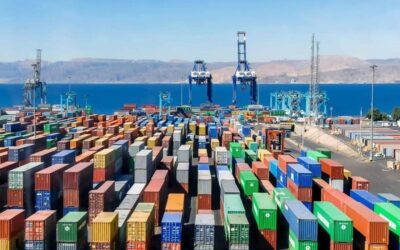
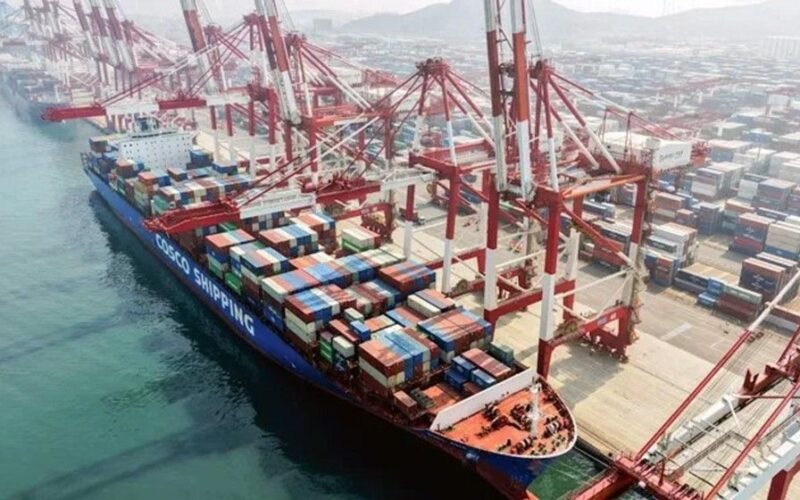
China’s share of global container exports has risen to around 40% based on a three-month moving average, highlighting the world’s second-largest economy’s growing reliance on external trade to support growth. The increase comes amid widening trade imbalances and concerns among trading partners over the impact of an influx of low-priced Chinese goods on jobs and domestic industries.
Data showed that China’s share increased by about 2.5 percentage points in just nine months, a pace that has exceeded the expectations of some European business officials. Jens Eskelund, president of the European Union Chamber of Commerce in China, said he had expected China to approach the 40% mark by 2030, warning that reaching the level sooner could lead to a significant expansion in trade imbalances, according to the Financial Times.
Growing Surplus
China recorded a global trade surplus of approximately $805.51 billion from January through August, putting the country on track to surpass last year’s record of $1.2 trillion. The figures come as the European Union considers imposing additional tariffs to curb the flow of Chinese imports.
Concerns have also continued in Europe and the United States that growing competitiveness among Chinese products could lead to job losses and accelerate deindustrialization. While China’s direct trade surplus with the United States has declined in recent years, some Chinese exports to North America reach the US market through third countries.
US President Donald Trump and Chinese President Xi Jinping were preparing to meet in Washington this week, with expectations that they would discuss extending the trade truce between the two countries. Trade imbalances remain one of the key issues in economic relations between the world’s two largest economies.
Widening Trade Gap
The European Union Chamber of Commerce in China issued a 398-page report calling for reforms across several Chinese industries, including medical devices, financial services and shipping, with the aim of improving European companies’ access to the Chinese market amid growing concerns over the widening trade gap.
Eskelund said Europe exported one container to China for every 2.5 containers China exported to Europe in 2019, before the COVID-19 pandemic. During the first eight months of this year, however, the ratio had shifted to one European container for every six Chinese containers, reflecting a widening imbalance in trade flows between the two sides.
The European chamber attributed part of the problem to China’s focus on expanding manufacturing and production rather than addressing weaknesses in its domestic economy, particularly the prolonged property-sector crisis, which has weighed on consumption and weakened domestic demand. Factories, meanwhile, have continued to increase output at a pace far faster than the growth of the domestic market.
Production and Consumption
China’s retail sales increased by just 0.4% in August from the same month a year earlier, while industrial production rose 5.3% during the first eight months of the year. Eskelund described the disparity as an indication that production in some comparisons is growing more than ten times faster than the domestic market.
The European chamber described trade as the “single largest contributor” to tensions between China and the European Union, noting that China’s trade surplus with the bloc reached around €1 billion per day last year. It linked part of the surplus to the rapid expansion of manufacturing capacity compared with limited growth in consumption.
China has rejected accusations of overcapacity, saying its competitive advantage in industries such as electric vehicles, solar panels, batteries and steel is based on competitive strengths rather than policies aimed at flooding overseas markets.
China’s Defense
China’s Xinhua News Agency defended this position by citing examples of products exported by other countries to global markets, including US Boeing aircraft, German cars, Japanese machinery, South Korean semiconductors and French luxury goods. It argued that describing production exceeding domestic demand as “overcapacity” is an oversimplification of the global economy.
Xinhua said applying such a definition broadly could turn international trade and the global division of labor into a problem and potentially undermine the concept of comparative advantage, which underpins a significant part of the global trading system. China maintains that its exports reflect its competitiveness and the level of overseas demand for its products.