
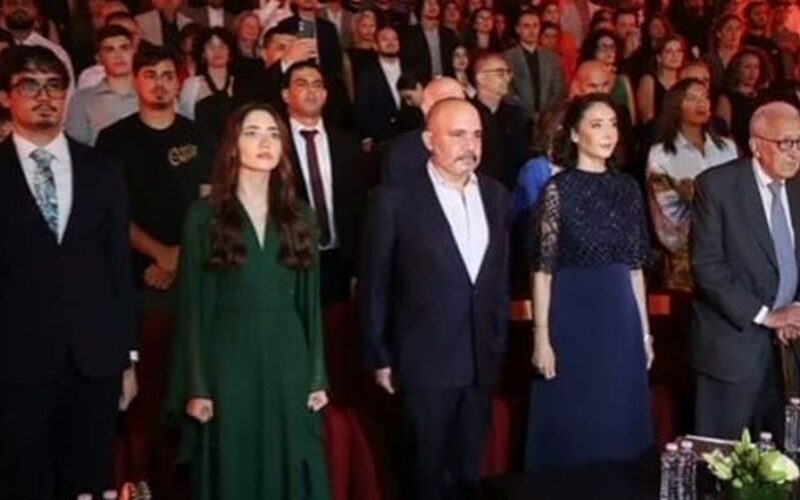
It commenced, as such moments often do, with the quiet act of reading—an otherwise unremarkable pursuit that would, in an instant, yield something altogether extraordinary. The coverage of the 7th Amman International Film Festival – Awal Film unfolded before one’s eyes, tracing the ceremonial splendour of the opening night at the Al Hussein Cultural Centre last week.
The presence of HRH Prince Ali bin Al Hussein, representing His Majesty King Abdullah II, and HRH Princess Rym Ali, presiding, bestowed upon the evening a regal gravity befitting the occasion. It was, by any measure, a celebration of cinematic artistry and Jordan’s growing cultural vitality.
And then, the gaze fell upon the photograph.
There, standing alongside HRH Prince Ali bin Al Hussein, HRH Princess Rym Ali, and their children—HRH Princess Jalila and HRH Prince Abdullah—was a figure whose presence arrested attention with quiet force. A countenance encountered countless times in the corridors of global diplomacy, within the hallowed chambers of the United Nations, and across the pages of modern history.
It was Lakhdar Brahimi.
The legendary Algerian diplomat. The consummate statesman. The man who devoted his life to grappling with some of the most intractable conflicts of our age. And yet, in that singular frame, he was not the formidable envoy addressing the Security Council. He was a father, witnessing his daughter’s moment. A grandfather, surrounded by his family, sharing an evening of quiet warmth in the heart of Amman.
In that moment, time itself seemed to pause. The mind wandered—not to the halls of the United Nations, but to the remarkable life that Brahimi has lived, and to the history through which he has quietly walked.
For decades, he was among the United Nations’ most trusted mediators—a man called upon when diplomacy had reached its most difficult hour. From Afghanistan to Iraq, from Syria to South Africa, Brahimi brought not only formidable experience but also patience, restraint and an unwavering belief that even the deepest conflicts demanded dialogue before despair.
Yet, for all his extraordinary achievements, it is perhaps his character that leaves the more enduring impression. In an era often defined by transactional diplomacy and cynical realpolitik, Brahimi earned respect not through grandstanding but through quiet authority. Those who worked alongside him have consistently spoken of his humility, courtesy and steadfast integrity. He understood that diplomacy was never about the diplomat; it was about the people whose lives depended upon peace.
And now, in his 92nd year, he stands in Amman—not as a diplomat, nor as an envoy, but as a father and grandfather. He stands beside his daughter, HRH Princess Rym Ali, whose own contribution to public life has taken a unique path, championing culture, dialogue and the power of storytelling. He stands among his family, witnessing another generation making its own contribution to the Arab world.
Perhaps that is the quiet beauty of the photograph. It reminds us that even those whose names become part of history remain, before all else, fathers, mothers, sons and daughters. Public service may shape a life’s work, but family gives that life its deepest meaning.
Brahimi’s name will long endure in the study of diplomacy and international affairs. Future generations will continue to examine his role in some of the defining negotiations of the modern era and the principles that guided his public service.
Yet, on that evening in Amman, the photograph offered something that no diplomatic communiqué or history book could capture: a father witnessing his daughter’s accomplishment with the quiet dignity that has long defined his own life.
And on that evening, beneath the lights of the Al Hussein Cultural Centre, Brahimi’s presence seemed to extend beyond the walls of the festival itself. Not because of titles once held or offices once occupied, but because of the life they represented. For, in the end, it is not only the positions we hold that define us, but the principles we uphold, the people we inspire and the legacy we leave in those who follow us.
Lakhdar Brahimi in Amman: a father, a diplomatic legend, and a name that will always echo through history.
* Khalid Dalal holds degrees from the University of Jordan and the University of Leicester, and has completed senior executive programmes at Columbia University, Harvard University and the Royal Military Academy Sandhurst. He writes regularly on diplomacy, leadership, strategic communication and international affairs.
Related Stories

Fiscal Discipline Shields Jordan’s Economy

Distributing the Cost of War