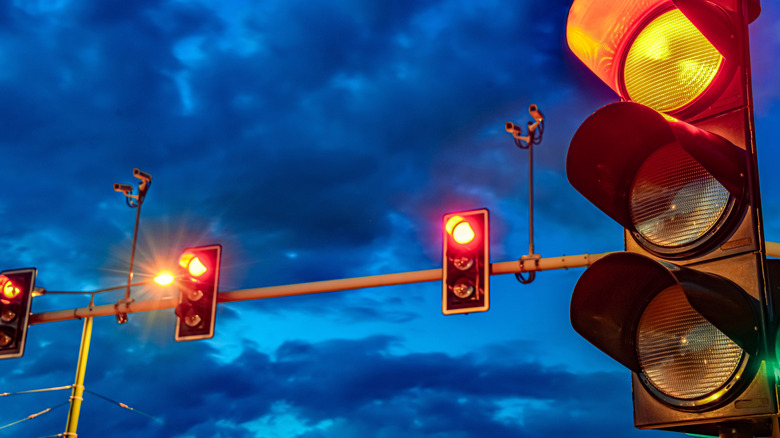
One of the most important safety advancements to happen to the world of wheeled transport, is the traffic light. If you have a driver’s license, you already know how it works; if the light is red, it means stop, and when the light turns green, it means go. In the United States, when the green light is up, the amber light comes on letting you know it’s time to slow down before it turns red. In Europe, that happens as well, but also, before they turn green, European traffic signals will enable both the red and amber light at the same time.
The amber and red lights illuminating simultaneously indicates that you should prepare to set off. That makes sense and considering Europeans use manual transmissions a lot more, it gives you just the right amount of time to push the clutch in and shift into first.
In some European countries, the green signal also flashes a couple of times to let you know that it’s about to turn red. In the U.S., the amber light does not come on before the change from red to green.
Other key differences between European and American traffic signals
European traffic signals have a few other differences compared to American traffic signals. The colors are the same, and the colors on traffic lights have a pretty interesting origin story. One of the differences is the amber light flashing on its own; American traffic lights have this as well, but it’s usually to warn of pedestrians or other road hazards that are coming up, or they indicate that you should yield to oncoming traffic and pedestrians if you’re making a turn.
In Europe, a flashing yellow traffic light often means that the signal has been disabled, and that you should pay attention to the road sign directly above the traffic light (which could be either right of way or yield). Traffic lights are always disabled when police officers are guiding traffic, and at that point, their signals take precedent over everything else.
What’s more, European traffic signals are also designed around pedestrians and cyclists, since a lot of cycle lanes are often directly next to the road. Speaking of pedestrians, whereas most traffic lights in America will display Walk and Don’t Walk in big capital letters, European traffic lights simply use stick figures. Rhythmic clicking or beeping is also common for pedestrians with impaired eyesight.
A camera placed near or on the traffic light is common in Europe and the U.S. It can be a red-light camera in some European countries and cities, but more often than not, it’s a speed camera that fines you automatically if you’re going above the speed limit.