5 Old-School Tools In Your Grandparents’ Garage That Are Worth More Than They Look
We may receive a commission on purchases made from links.
Over time, it’s incredibly easy to accumulate piles of tools in a garage, shed, or home workshop. Unfortunately, this means lots of old rusty junk to sort through when the time comes to clear the space out — especially if the space is that of your grandparents who’ve collected tools for decades. There are plenty of tools that never get used and should be tossed, those worth keeping around, and a rare few that fall somewhere in the middle: Old-school tools that may not be worth using in the modern era, but are worth holding onto or selling off due to their monetary value.
On the whole, just because tools are old doesn’t mean they’re worth a pretty penny; antiquated power tools from defunct brands and rusted hand tools from the early 20th century aren’t guaranteed moneymakers. With that said, there are some that longtime collectors could have around that fetch a few bucks. In some instances, their branding, build quality, rarity, and other factors come into play, making them sought-after pieces of tool history worthy of display or even occasional use.
The next time you’re looking through your grandparents’ garage or sifting through a flea market tool pile, keep an eye out for some of these items. You may just stumble upon a collector’s dream piece.
Russell Jennings auger bits
As mentioned, sometimes tools accumulate value due to the name attached to them. For instance, back in the late 19th and early 20th century, the Russell Jennings Manufacturing Company specialized in tools like chisels and auger bits. The company closed its doors in 1942 when The Stanley Works Inc. — now known as Stanley Black and Decker, the owner of several tool brands — purchased it. In the aftermath, Jennings tools took on the Stanley label, making older Jennings-branded bits rather pricey if you can find a complete set in good shape with the original three-tier wood case.
Should you go antique tool-hunting and find a complete, non-worn out authentic Jennings auger bit set, there could be some decent money in it for you. On the low end, eBay sale records indicate these kits go from around $45 to $60 on the low end to between $150 to over $200 in some instances. Some individual bits have even fetched between $20 and $30 on their own, which isn’t life-changing money, but it could beat having a bunch of century-old auger bits sitting around and collecting dust.
Davis level
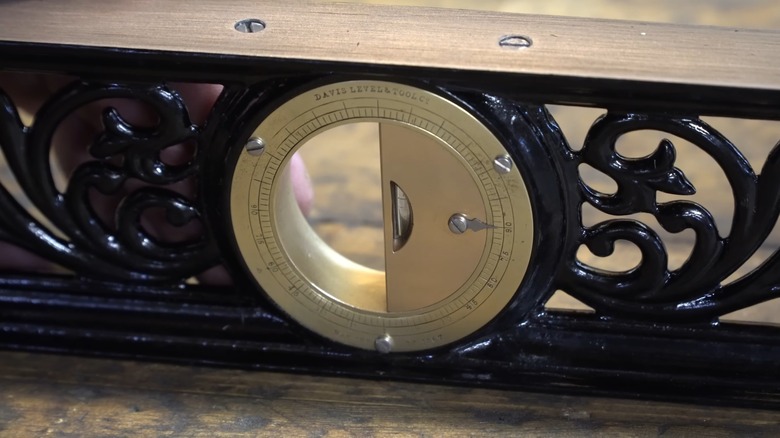
A level is a simple yet crucial tool, ensuring a surface is sufficiently straight. The tool has advanced, with some even opting to use red or green laser levels depending on the situation, but there’s still plenty of love for antique models. Look no further than those from the Springfield, Massachusetts-based Davis Level and Tool Company, which dates back to the 1800s. In the modern era, they’re known and sought-after by collectors for their unique shapes and ornate detailing. That’s to say they’re aesthetically a far cry from current plastic or metal levels, and the same goes for their sold prices and desirability.
It doesn’t take much looking around online to tell that antique Davis levels are well-loved among antique tool enthusiasts. Depending on their condition, material, size, and shape, these tools have fetched anywhere from around $30 to $40 on the low end to well-over $400 for more ornate examples. Generally speaking, the wooden levels tend to go for less than those made from cast iron, even if they’re in need of some restoration. No matter the material, though, if you spot a Davis level, it’s more than worth getting ahold of.
World War II-era Snap-on tools
Throughout the Second World War, several companies contributed to the war effort by providing their wares to the United States government and military. Prolific tool-maker Snap-on joined this trend, supplying various hand tools to repair vehicles, appliances, and more. While untold numbers of Snap-on tools didn’t last through to end of the war, many sockets, wrenches, and ratchets did, becoming desirable collector’s items. While some items from the era are only worth around the $15 to $30 mark, others have sold for multiple hundreds of dollars. Ultimately, it comes down to what you have, how many pieces, and what their markings reveal.
Overall, World War II-era Snap-on products will go for more than the average old tool, but some demand significantly more than others. Much of this value can come down to the Snap-on date code stamped onto the tool, which reveals when it was made and, in some instances, for what purpose. Those emblazoned with a G symbol were made for government use way back when, making them wanted among tool lovers, history buffs, and military enthusiasts alike. Thus, if you find some old Snap-on tools with that telltale mark, at the very least it’s a good idea to do some research into their history and potential increased worth almost a century after their creation.
Goosewing axe
While many tools don’t see a lot of use time before breaking down, a rare few go the opposite direction. Some of the longest-lasting tools are surprisingly old yet still useful, going through job after job without fail. Axes are one such type, with there being functional samples that are centuries old still floating around today. Case in point are antique goosewing axes, which had their heyday throughout the 1700s and 1800s as the go-to tool for wood hewing. Given their historical significance, functionality, and durable nature, many antique tool collectors would love to add them to their collections.
As desired pieces, goosewing axes can go for big money on the aftermarket
It’s not unheard of for short-handle samples to fetch between $75 and $200 online, depending on their age and condition. Even the head of such an axe can creep up around $100. In some rare cases, complete samples have even gone as high as $400 to beyond $1,000 at auction, again with elements like size and condition playing a major role in their final sale prices. The moral of the story is, even if that rusty axe in the corner of the garage doesn’t look like much, don’t be so quick to pass it over without doing some research.
H.D. Smith ball peen hammers
Hammers are a dime a dozen and have been for decades. With that said, not every simple hammer is an item to disregard when digging through a pile of old tools. Some are worth keeping an eye out for, as they do go for quite a bit all these years after their creation. Look no further than the H.D. Smith ball peen hammer, a specialized tool that reached consumers in the early 20th century. These were known for their high quality and use of Smith’s “Perfect Handle” design that numerous of the brand’s tools used. Now, they’re pretty pricey collector’s items.
Compared to a new ball peen hammer, antique Smith samples aren’t for the budget-conscious. Recent online auction data indicates these hammers can sell for anywhere between $70 to over $100. Per usual, condition is a factor as well as the size of the hammer in question. Based on samples sold online, Smith ball peen hammers tend to sit between 9 and 10 inches in handle length. The Perfect
Handle design means the wood portion should stop about halfway up and be rounded off on both ends.
How these tools were selected
A thorough process went into selecting these specific old yet valuable tools. The first step involved looking around and what tool collectors and archivists had to say on the matter. This informed which direction the research should take, as these sources pointed out specific brands, types, and certain iterations of antique tools that had proven desirable and valuable. These products also had to be relatively common, excluding anything so old or severely limited in production number that the odds of finding these in a grandparents’ garage or tool sale were slim to none.
From here, qualifying tools needed to have a robust sales records that also proved collectors are willing to drop quite a bit of money on them, at least compared to what modern equivalents or less valuable antique samples might cost. This way, the claim that these specific items go for a pretty penny had sufficient online backing. This involved consulting recent sales from online auction houses like eBay, ensuring that these items do commonly sell for well beyond what people might expect them to go for at first glance.