
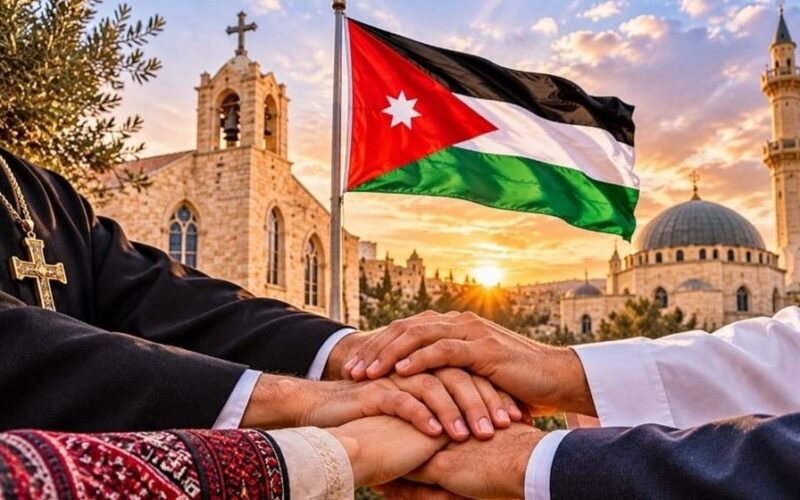
A funeral should be a moment when a community gathers to honour one of its own. A week ago, in Hamoud, in southern Karak, people assembled at St George’s Greek Orthodox Church to pay their final respects to a member of their community.
Then, in a sudden and brutal act of violence, three cowardly terrorists opened fire, turning that solemn gathering into a scene of slaughter.
Yet what followed revealed something neither the perpetrators nor those who planned and supported their actions could ever have anticipated: in Jordan, grief does not divide people; it summons their deepest instincts of belonging and national unity.
His Majesty King Abdullah II vowed that the terrorist attack against Karak would be met with “the harshest retaliation”. Within 48 hours, those responsible had been apprehended.
Their Majesties King Abdullah II and Queen Rania Al Abdullah, alongside His Royal Highness Crown Prince Al Hussein bin Abdullah II, stood with the bereaved. Government officials, the armed forces, intelligence services and security agencies responded with determination.
From the highest office to the ordinary citizen in the street, Jordanians stood together. Christians and Muslims mourned as one.
This is more than a moment of shared grief. It is an enduring bond, forged over generations through shared experiences, common hardships and steadfast loyalties.
Jordan remains one nation in times of peace and conflict, in celebration and in sorrow. Its unity does not depend upon uniformity of faith; rather, it rests upon the profound conviction that we belong to one another.
When one community grieves, the entire nation feels its pain. Hamoud has given that truth an even deeper resonance.
Beyond our borders, young men and women watched with admiration and an unmistakable yearning for the unity they had witnessed.
Across social media, their words conveyed a powerful question: why could their own homelands not offer them the same reassurance? In a region whose people have endured profound challenges and divisions, where innocent lives are lost and their deaths are too often reduced to passing headlines, they witnessed something deeply moving in Jordan: a country that treats every citizen’s life as precious, whose leadership stands firmly by its people, and whose society refuses to leave anyone to face grief alone.
They were not merely expressing admiration; they were voicing a heartfelt wish to call Jordan their home.
Jordan’s resolve extended beyond its borders, as the Royal Jordanian Air Force struck terrorist hideouts in southern Syria. The Kingdom will safeguard its people and defend its security.
Yet its strength resides not solely in its capacity to confront threats, but in the shared purpose and national kinship that define its character.
Perhaps that is why so many, looking towards Jordan from across a troubled region, wish they were Jordanians. Not because tragedy cannot reach us, but because we have steadfastly preserved the meaning of belonging.
A country becomes a homeland when no one is abandoned to face the darkest hour alone.
In a turbulent neighborhood, Jordan remains an oasis of stability and security because its people, from His Majesty the King to every one of us, stand together. That is Jordan, a country so many others yearn to call home.
Related Stories
‘Why Were We Left Alone to Bleed?’ – The Echo of Palestine’s Endless Cry
How Will Jordan Settle the Battle?