
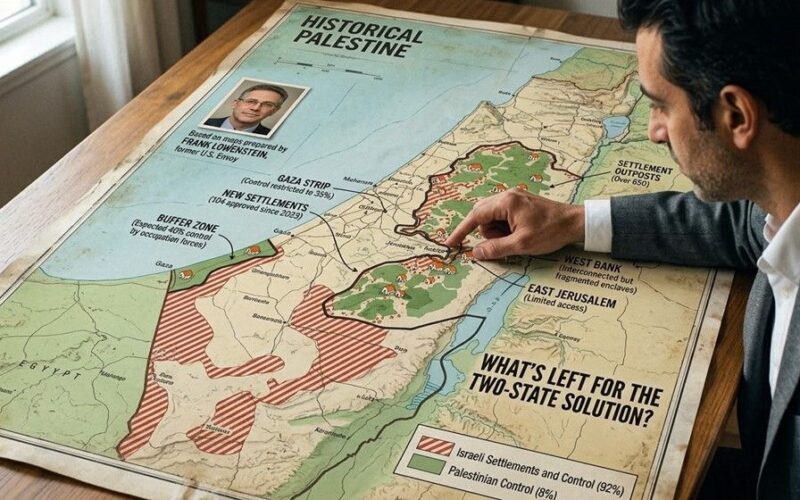
What actually remains of the chances for a two-state solution is exactly equal to the area currently available for Palestinian control: just 8% of the area of historical Palestine, according to a lengthy investigation by the American magazine The New Yorker, published recently, based on maps prepared by Frank Lowenstein, the former U.S. envoy to the Israeli-Palestinian negotiations.
Lowenstein’s maps, drawn up while he served as envoy during President Barack Obama’s administration, clearly show that the area that “could” fall under Palestinian control does not exceed 8% of historical Palestine, compared to Israeli control over roughly 92%.
Perhaps the most alarming thing the American magazine’s presentation of the former envoy’s analysis reveals is the terrifying acceleration in settlement activity since 2023, particularly after the events of October 7. Officially documented data shows that the occupation government approved the establishment of 104 new settlements, a number that continues to rise, and granted licenses for the construction of roughly 60,000 settlement housing units. Settlement outposts have nearly doubled, reaching more than 650.
The expansion of areas under Israeli occupation control is not only due to accelerated settlement in the West Bank and occupied Jerusalem, but also to occupation forces’ invasion of Gaza and their imposition of control over roughly 65% of the Strip’s territory. Just a few weeks ago, Netanyahu promised to expand control to cover 70%.
Even under the best case scenarios for a potential Israeli withdrawal from Gaza, occupation forces are expected to retain control over no less than 40% of its territory as a security buffer zone.
Envoy Lowenstein believes these developments have completely changed the course of the discussion: the question is no longer “What can we do to reach a two state solution?” but rather “What can be done to prevent Israel from literally seizing the entire land?”
The difficult, perhaps impossible, task facing the international community, given all these facts, is that any vision of a viable Palestinian state requires, alongside halting settlement expansion, a large scale evacuation of existing settlements and outposts.
Given the rise of the right wing in Israel, its takeover of the entire political map there, and the shift of broad segments of Israeli public opinion toward supporting the most extreme right wing tendencies, it seems entirely unreasonable to expect such a scenario in the foreseeable future.
In practical terms, the status quo in the occupied Palestinian territories no longer exists as it once did. Palestinians have not abandoned their homeland, and they have paid a heavy price for holding onto their land. But practically speaking, what value does a Palestinian population majority have if the larger share of Palestinian land is in the hands of the occupiers?
The Palestinian, Arab, and international demand, grounded in resolutions of international legitimacy, has not changed. The establishment of an independent Palestinian state requires the withdrawal of occupation forces from the territories occupied in 1967, including East Jerusalem. That keeps the Palestinian people’s cause alive and legitimate. Yet the change occurring on the ground will render the resolutions of international legitimacy unworkable.
Israel is betting on imposing facts on the ground, something it has succeeded in achieving over long decades. The international community shows no serious willingness to impose its conditions on Israel, while the entire issue is being transformed into a matter of a population for whom the occupying state merely needs to provide the conditions of a decent life, nothing more.
Related Stories
Jerash… When Art Becomes a Message of Security and Confidence

Public Debt: From Balance Management to Portfolio Management