
What Is The Difference Between Impact Wrench Sizes?
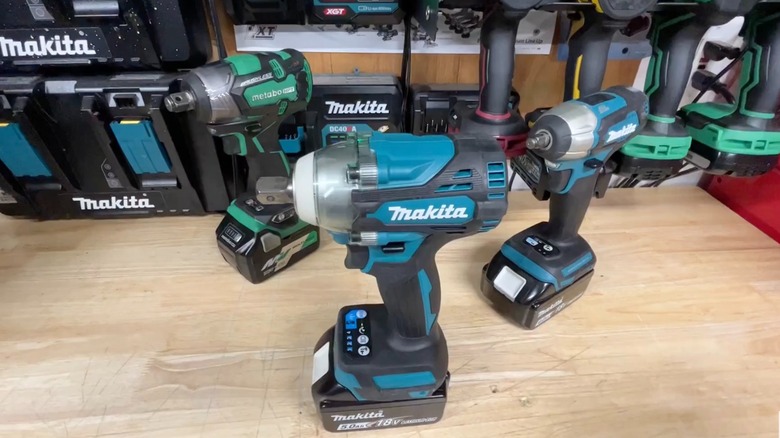
Impact wrenches tighten or loosen fasteners more effectively than you typically can by hand, doing so using a hammer and an anvil mechanism. If those fasteners, such as nuts and bolts, don’t match the socket and tool head, the tool won’t tighten or loosen the fasteners correctly, if at all. Impact wrenches come in five main sizes: ¼-inch, ⅜-inch, ½-inch, ¾-inch, and 1-inch drive. Of these, the three most commonly used sizes are ¼-inch, ⅜-inch, and ½-inch. Most of the best major cordless impact wrench brands will offer tools in at least these three sizes.
These sizes measure the impact wrench’s anvil, which is the square-shaped piece of metal sticking from its head. Impact wrench sockets attach to this square. While adapters let you use sockets with different drive sizes, they may not be as powerful as using the tool directly and can wear down the impact wrench over time. That’s why the type of work and fasteners you’re using will typically determine which impact wrench size you need.
Generally speaking, large, heavy-duty equipment uses bigger fasteners. So the largest sizes, like 1-inch fasteners, are more common in industrial settings than the very smallest, which are more likely to be found on more everyday products.
Different impact wrench sizes are useful for different tasks
Typically, the smaller the drive, the less power the tool will <a href="https://jordangazette.com/is-the-leatherman-arc-worth-the-price-owners-have-this-to-say-about-it/”>have. Generally, ¼-inch-drive impact wrenches deliver between 30 and 60 lb-ft of torque, enough for small screws and more delicate electronics. A ⅜-inch drive is slightly larger and can be used for smaller cars and engines, especially since larger impact wrenches are tougher to operate within the confines of an engine bay. A ⅜-inch drive impact wrench can generate anywhere from 50 to 250 lb-ft of torque, or thereabouts.
The ½-inch drive is arguably the most commonly used impact wrench size of all. That’s because it’s often used for applications where a decent amount of torque — but not too much — is called for. It’s often the size used for lug nuts on the tires of most passenger cars and light trucks, as well as vehicle applications. A ½-inch drive impact wrench is also used commonly in construction, and you can expect these to generate 250 to 1,000-plus lb-ft of torque.
When more power is needed, it’s time for ¾-inch drive impact wrenches. These easily deliver more than 1,000 lb-ft of torque, with some capable of generating around 1,500 lb-ft. This kind of force is useful when working on trucks and larger machines. Even bigger vehicles and industrial machines, such as buses and tractors, will have huge bolts that require a lot of torque to tighten and loosen. That’s when 1-inch drive impact wrenches come in handy, as they should be able to generate 2,000 lb-ft or more of torque.
How do you determine the size of the fastener you’re working with?
It’s very important to match the fastener’s size to that of the socket and drive of your impact wrench. Sometimes, it’s not immediately clear what size a nut or bolt is, though. When that’s the case, the best course of action is to check the service manual or fastener data sheet. If those are absent, you can often find digital versions online. The torque requirements listed in these specs — whether in Nm or lb-ft — will give you a sense of what size impact wrench you’ll want to use.
That said, it’s important to remember that the size of an impact wrench drive doesn’t correlate to the thread size often used when describing bolts and other fasteners. Fastener sizes are found in either metric or standard, the latter of which is usually referred to as SAE, which is an abbreviation that doesn’t directly apply to sizes at all.
Thread sizes are often described as M1, M2, and so on, with the number following the M equating to the thread diameter in millimeters. Larger thread sizes typically mean larger bolts. Many automotive fasteners range between M6 and M16, while heavy-duty bolts usually have thread sizes of at least M18. Anything above M36 is usually only found in industrial applications. So, while thread sizes don’t directly correlate to impact wrench sizes, they will often tell you what size tool you’re going to need to use.