
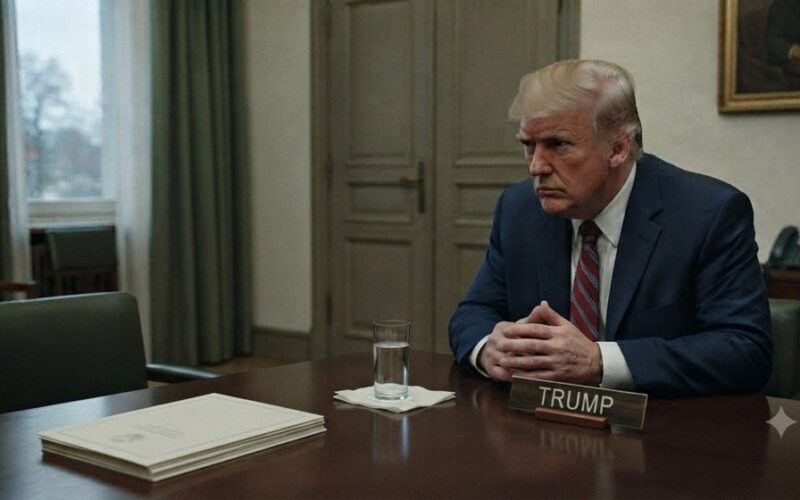
How many times has Donald Trump threatened Iran with a crushing attack after the Forty-Day War? Media outlets have counted ten such threats over the past five months, highlighting a striking lack of strategic clarity in a war whose objectives have shifted constantly.
Each time, Trump has repeated the same justification for backing down: an agreement was supposedly close to being signed, covering both the Strait of Hormuz and Iran’s nuclear program. Yet no such agreement materialized.
Tehran continued to maneuver, gaining ground on both the military and political fronts. It expanded its operations across the region and continued to wage proxy wars in several countries. Even before Trump’s latest threat, Iranian drones had reached the vicinity of Egypt, while Tehran had raised its threats to include European countries.
The broader picture reveals an unprecedented level of American confusion and a serious miscalculation that has characterized the conflict from the very beginning or rather, even before it started.
The war’s underlying assumptions were overwhelmingly shaped by Israel, which had counted on a dramatic collapse following the initial strike that eliminated Iran’s Supreme Leader along with senior military and political figures.
Trump now says, as he has on previous occasions, that Iran and regional countries asked him to postpone a major attack and give diplomacy a chance to achieve a swift agreement.
There is no doubt that this is true. This time, Tehran owes Saudi Arabia in particular a debt of gratitude for helping spare it from devastating attacks that would have further intensified the suffering caused by the war.
Had the Iranian leadership appreciated the positions taken by neighboring Arab states earlier, it might have generated enough political momentum to prevent the war from breaking out in the first place.
At the same time, however, Trump has repeatedly used the Arab world’s opposition to war as a convenient excuse to mask his own predicament and avoid a military confrontation that could have severe consequences for U.S.
forces and the interests of America’s allies. Those allies have already borne enormous economic and security costs and can no longer afford further escalation.
The current window for de-escalation, if Trump’s account is to be believed, is a narrow one. Many are betting that a president whose popularity has declined sharply ahead of crucial midterm elections will not dare return to war.
Nevertheless, influential regional powers and mediators must act more decisively to capitalize on this opportunity and reach an agreement that addresses the various outstanding issues before Israel once again revives the momentum for war.
Tehran, too, must demonstrate wisdom and restraint in its approach to a political settlement.
It would be inappropriate for Iran to behave toward its Arab neighbors as though it emerged victorious. Its war was with Washington and Tel Aviv. The countries of the region paid the price for that conflict and worked tirelessly to bring it to an end.
What distinguishes this opportunity from previous ones is its timing. Tehran understands this well. Trump does not have much room to maneuver before the midterm elections.
If he reaches that point without a political agreement he can present as a victory, he may be tempted to pursue a military gamble in search of a battlefield success one that could resonate more strongly with Republican voters than diplomacy.
This means that time is pressing on both sides, even though Tehran appears willing to drag out the process until the U.S. midterm elections, hoping Trump will pay the political price for what it views as his failure in the war.
Such an outcome could weaken his dominant influence in Congress, leaving him unable to launch another war or even negotiate a deal on his own terms.
Related Stories

Anonymous Media

This Refusal Comes at a Price