
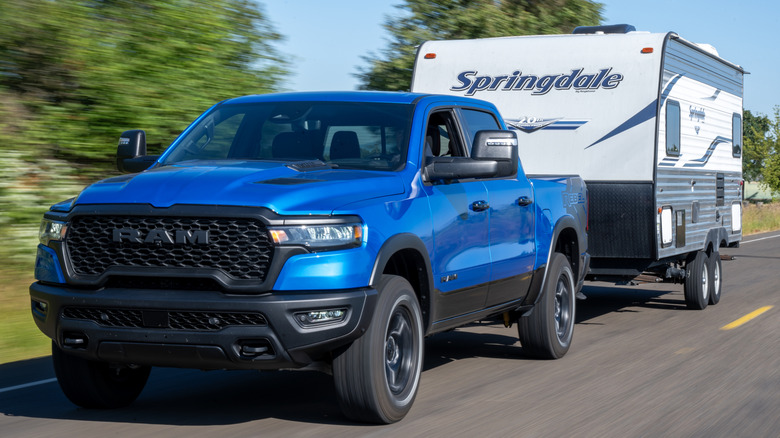
Towing On Bumpy Roads Or In Crosswinds? These Things Might Help You
If you find yourself towing a trailer of some type and you experience either rough roads, crosswinds, or even both, there are some solutions that could help you handle a very challenging situation. Let’s start with the concept of weight distribution. The primary rule that pertains here is known as the 60/40 trailer rule. This states that around 60 percent of the total cargo weight should be placed in the front half of your trailer. A good way to do this is to make sure that the heaviest items are placed up front. You’ll also want to balance the weight evenly between the left and right sides of the trailer. Once everything is in the trailer and distributed properly, tie everything down securely so that nothing can shift around as the trailer proceeds down the road. This is a good place to start.
Another helpful feature for towing a trailer in crosswinds or bumpy conditions is a sway control system. This feature can help if your trailer starts swaying while towing, which is caused by either poor weight distribution in the trailer or driving too fast while towing (and can be exacerbated by strong winds or poor road surfaces buffeting the trailer). These systems can either be built into an aftermarket trailer hitch or can be part of a tow vehicle’s stability system.
Then there is the trailer brake controller, which applies the trailer’s brakes anytime that the tow vehicle’s brakes are used, making the overall braking process much smoother. The amount of braking that is provided by the trailer can be adjusted with a control inside the tow vehicle.
What else you should know about towing a trailer on bumpy roads or in crosswinds
Let’s dive deeper into the details on sway control systems. The hitch type of sway control works by adjusting the tongue weight of the trailer, assuring that it is evenly distributed so that the towing vehicle remains solidly planted on the road surface. When it comes to built-in, vehicle-based sway control systems, these are designed to slow down your vehicle if it detects trailer sway, applying the brakes and even reducing engine power until the swaying stops. Ford, which offers the latter sway control system on select vehicles, also recommends that if your trailer starts to sway, you immediately slow down, pull off the road and stop before checking that your trailer is properly connected and your load is distributed correctly, after which you should proceed on your trip at a lower speed.
While not every tow vehicle has them, trailer brake controllers have gotten more sophisticated over the years. Older tow vehicles so equipped came with more basic controls, while more recently produced trailers have much more complex settings with many different types of electronically-integrated braking systems to choose from. Be sure to watch the instructional videos for your specific make and model of tow vehicle to understand your vehicle’s trailer brake controller system.
Towing a load for the first time can be scary, but if you do your research, load your trailer properly, hook it up correctly, and don’t drive too fast, you should have a positive experience — even if you encounter heavy crosswinds or bumpy road surfaces. And don’t forget these four simple yet essential items you should have when towing a trailer or camper.