
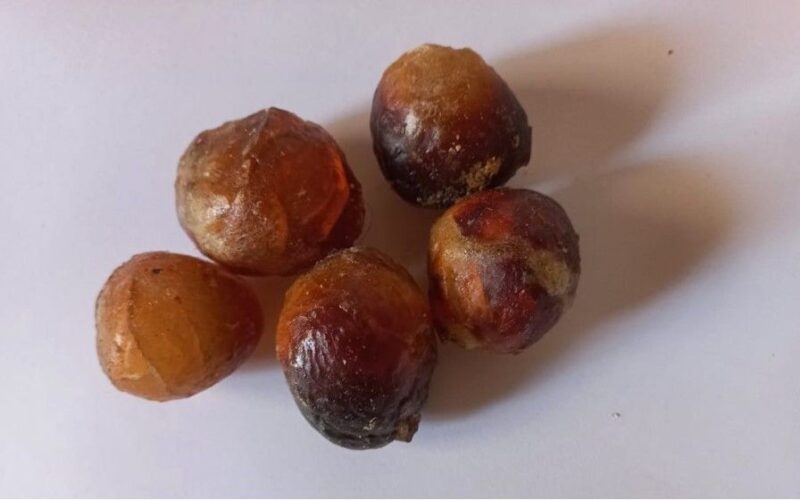
This article presents an experimental observation concerning the long-term transformation of egg white into a hard, brown, semi-translucent material with an appearance resembling amber.
The observation was made by Dr. Abbas Haddadin through the preservation and examination of egg-white samples over a long period of time. The transformed material developed a brown to amber-like appearance and became solid, while the yolk remained visibly different and did not undergo the same transformation.


The observation raises a question about the physical and chemical changes that may occur in egg white during prolonged drying and aging. The resemblance in color, translucency, and general appearance to amber is presented as an experimental observation, not as evidence that natural amber is derived from egg white.
An Experimental Observation
In my experiments, I separated egg white from the yolk and preserved the egg-white material for an extended period.
With time, the egg white changed from its original transparent and viscous state into a harder material with a brownish to amber-like appearance. When observed under light, parts of the material showed translucency, producing an appearance visually comparable to some pieces of amber.
This transformation was particularly interesting because the yolk did not show the same type of transformation. In old eggs that I examined, the egg white had changed substantially while the yolk remained recognizable.
These observations led me to investigate the material more closely and to document its appearance photographically.
Microscopic Observation
Microscopic examination of dried egg-white material showed structures appearing as masses and granules within the transformed material.
These observations are important because they demonstrate that the material is not simply unchanged liquid egg white. It undergoes a visible transformation during prolonged drying and aging.
The photographs accompanying this article document the experimental material itself.
Figure 1. Egg-white material photographed under transmitted light, showing its transparency and internal appearance.
Figure 2. Dried and transformed egg-white material photographed without direct transmitted light, showing its brown to amber-like appearance.
A Question Concerning Leonardo da Vinci
The observation also led me to reconsider historical descriptions of painting materials used during the Renaissance.
Leonardo da Vinci conducted experiments with painting materials, and egg products were known to artists as components of traditional painting techniques. Egg white has adhesive and binding properties and can form a hard film after drying.
Based on my own experiments, I propose as a hypothesis that egg white, potentially in combination with other materials such as linseed oil, may have had applications in historical painting techniques.
This is presented as a hypothesis arising from my experimental observations. It should not be regarded as proof of the exact materials used by Leonardo da Vinci unless supported by independent historical and analytical evidence from his paintings.
Conclusion
My long-term observation demonstrates that egg white can undergo a substantial transformation during drying and aging, producing a hard brown, semi-translucent material that can visually resemble amber.
The significance of this observation is not that it establishes an origin for natural amber, but that it documents a previously interesting material transformation observed experimentally.
Further chemical and microscopic analysis would be required to determine precisely which chemical and structural changes are responsible for the transformation.
Dr. Abbas Haddadin
Related Stories

Subsidies between cost and fairness

Antibiotic enters Jordanian government's body