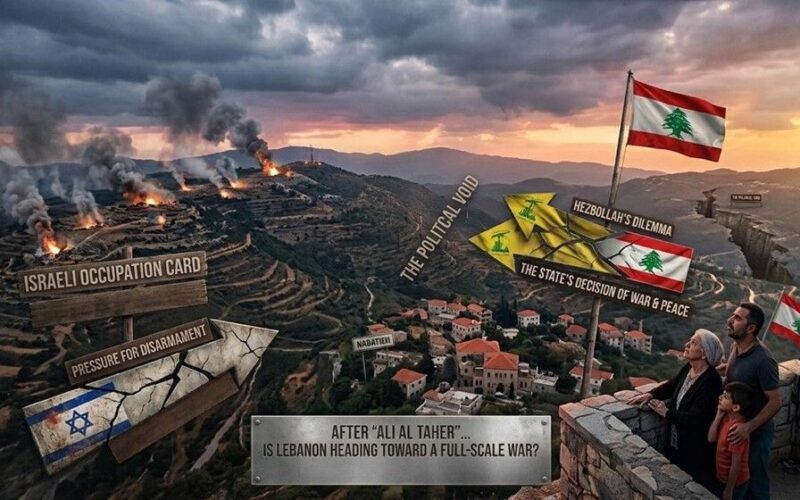
What is happening in the Ali Al Taher heights in southern Lebanon reveals that the war has entered a more complex phase than before. The conflict there is no longer just about Hezbollah’s capacity to respond or the Israeli entity’s capacity to advance, but about the shape of the equation that will be imposed on Lebanon once the fighting ends. The entity, having announced control over the heights, did not stop at describing it as a military achievement; it tied the continued presence of its forces there to the disarmament of Hezbollah, meaning the occupied land has turned into a political pressure card.
If we dig deeper into the analysis, we find that the importance of “Ali Al Taher” lies in its location, which grants whoever controls it a wide vantage over areas of Nabatiyeh and the south, and its connection to the chain of heights extending toward the Tuffah region and Jabal Al Rihan. This is why controlling it grants the Israeli entity additional depth and a greater ability to monitor movement in the area.
But turning this military gain into a final victory is an entirely different matter. After control was announced, the strikes did not stop; escalation continued and civilians were killed, confirming that the entity did not consider the battle over, and that the goal goes beyond controlling a specific position toward imposing a new security reality north of the Litani.
Hezbollah, meanwhile, finds itself facing its hardest set of choices. A strong response could give the entity a pretext to expand its operations, while silence could cement a new reality on the ground. As for handing over positions to the Lebanese army, the party fears this could become the start of a broader path toward disarming it. But the problem is that keeping weapons outside state control simultaneously gives the entity the pretext it uses to justify the continuation of its military presence. This is where Lebanon falls into the most dangerous loop: the Israeli entity says Hezbollah’s continued existence forces it to stay, while the party says the continuation of the occupation justifies its continued possession of weapons.
Unfortunately, standing between the two sides is the Lebanese state, the party paying the highest price while holding the least influence. This is why any serious solution cannot be built on disarming Hezbollah alone, nor on demanding the entity withdraw without security arrangements, because what is required here is a mutual settlement: a complete, clear, and guaranteed withdrawal by the entity, an actual deployment of the Lebanese army, alongside a political track to address Hezbollah’s weapons within the framework of the state.
For this reason, “Ali Al Taher” may not be the start of a full scale war, but it is certainly the start of a new phase, and the greater danger for Lebanon isn’t only the outbreak of a major war, but the south turning into an open, low intensity battlefield, punctuated by raids, assassinations, incursions, and faltering negotiations.
At that point, the question will no longer be who won the hill, but who gets to decide the shape of the new Lebanon afterward. The real battle is no longer over “Ali Al Taher”; it’s over who holds the decision of war and peace in Lebanon.
Related Stories
Two Questions About the War