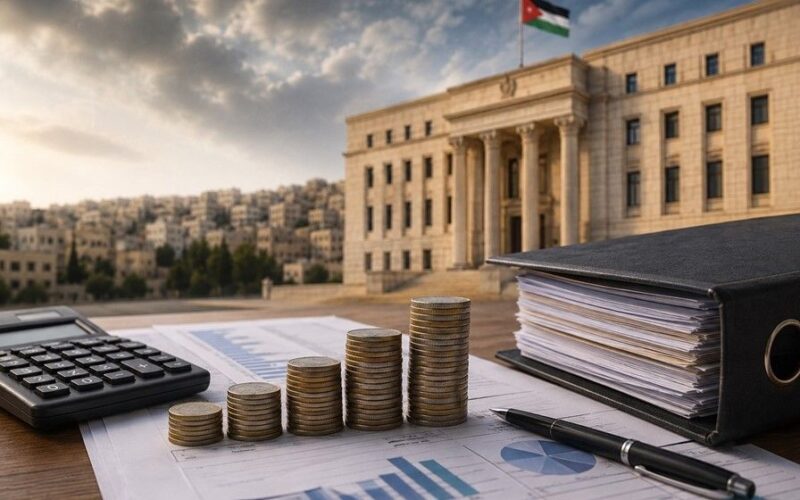
As the government prepares to draft the 2027 General Budget Law, what is needed this time is not simply a new budget with different figures, but rather a different fiscal philosophy based on discipline, efficiency, and sound resource management.
The Jordanian economy is entering the budget preparation phase amid complex regional and economic conditions, making every dinar in the Treasury more important than ever.
Regional developments, rising energy costs, fluctuations in shipping and insurance costs, and the possibility of higher prices for some basic commodities could all place additional financial burdens on the government, whether through increased subsidy costs or higher operational expenditures.
Under such circumstances, controlling public spending becomes a national necessity rather than merely a fiscal option.
The figures in the 2026 budget indicate the scale of the responsibilities borne by the Treasury. Domestic revenues stood at approximately JD10.196 billion, while current expenditures reached JD11.456 billion and capital expenditures amounted to JD1.600 billion, bringing total spending to JD13.056 billion. The deficit after grants was estimated at around JD2.125 billion, while the deficit before grants stood at approximately JD2.860 billion.
At the same time, the government continues to bear a significant subsidy bill to protect various groups and sectors. Subsidy allocations in the 2026 budget amounted to approximately JD1.03 billion, including JD171 million to support wheat and feed, JD80 million for subsidizing gas cylinders, JD280 million for the National Aid Fund, and JD124 million to cover cancer treatment.
The allocations also included JD210 million to support municipalities, JD80 million to support Jordanian universities, JD35 million for the Student Support Fund, and JD50 million for medical treatment and exemptions.
These figures demonstrate that the fiscal room for maneuver is limited, and that any increase in global oil or commodity prices will have a direct impact on the Treasury, whether through higher subsidy costs or increased spending on essential services.
This makes it necessary for the 2027 budget to be built around the principle of rationalizing expenditure rather than expanding it.
Government arrears data also reveal another aspect of the fiscal challenge. Total arrears and liabilities owed by the central government amounted to approximately JD1.4 billion, including around JD448.6 million owed to the health sector, JD399.6 million to the energy sector, and JD224.6 million to the water sector. During 2026, the government paid approximately JD375.2 million toward reducing these liabilities.
Here, a fundamental reality emerges: the success of the budget does not depend solely on the Ministry of Finance; it begins with every ministry and government institution. Every minister manages financial allocations, and every decision they make has a direct impact on the state of public finances.
Therefore, a successful minister is not the one who spends their entire budget allocation before the end of the year, but rather the one who can achieve their ministry’s objectives with greater efficiency and at a lower cost.
The coming phase requires a change in administrative culture, so that spending efficiency becomes a measure of the success of government institutions, and every project and expenditure is subject to an assessment of its economic and social impact.
Rational spending does not mean halting projects or disrupting services; rather, it means directing resources toward priorities that generate the greatest economic and social returns.
The 2027 budget should be a budget of genuine fiscal discipline, preserving the stability achieved in public finances and ensuring continued spending on essential priorities without placing additional burdens on the Treasury that can be avoided.
Under the current circumstances, the Minister of Finance is no longer the only person responsible for public money.
Every minister has effectively become a finance minister as well, because protecting the Treasury begins with the sound management of every dinar allocated to their ministry.