
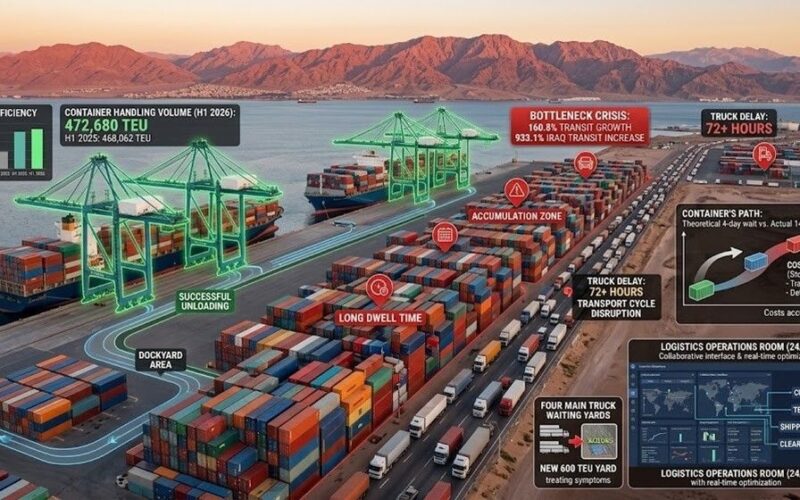
The Aqaba Port crisis is real, but it doesn’t reflect a weakness in receiving ships or handling containers. Rather, it reveals a gap between the success of operations inside the port and the ability of the logistics system to move goods out at the same speed. A container that cranes unload efficiently, but which then sits in the yards, quickly turns from an operational achievement into an economic bottleneck.
This crisis stems from the convergence of exceptional factors, including disruption to shipping lines due to geopolitical conditions, changing ship arrival schedules and canceled voyages, and rising transit traffic and container accumulation without a matching increase in the speed of moving them out of the system.
Operational indicators don’t deny the existence of the crisis — they define its nature more precisely. Aqaba’s container port handled 472,680 containers in the first half of 2026, compared with 468,062 containers in the same period last year, while Jordanian ports recorded a 35% rise in total handling during the first five months, reaching about 4.85 million tons.
But the more telling figure lies in the nature of the traffic: transit containers rose during the first seven months from 30,763 to 80,235, a growth of 160.8%, while containers headed to Iraq jumped from 3,599 to 37,182, an increase of 933.1%.
These figures put the crisis in its proper context. Total container traffic during the first half showed limited growth, while a sharp shift occurred in the routes and destinations of goods — shifting the pressure from the dock to the yards, gates, customs clearance, and trucks, and confronting the system with flows that not all its links were equally prepared to handle. This, therefore, is a comprehensive logistics crisis, not an operational problem confined to the port itself.
Against this backdrop, the container port’s declared capacity stands at 1.3 million standard containers, with the potential to raise it to 2 million through increased labor and operating hours. Aqaba also has logistics yards with storage areas reaching up to 2 million square meters. But theoretical capacity loses its value when a container’s dwell time lengthens and its turnover speed declines.
The real bottleneck — the essence of the crisis — is measured not just by the dock’s capacity to unload a ship, but by the time a container needs to leave the system. Every additional day raises the costs of storage fees, warehousing, detention, and transport, freezes importers’ funds, delays exporters’ work, and these costs then pass on to markets and consumers.
In the same vein, trucks being delayed for days at certain crossings takes them out of the transport cycle and prevents their return to Aqaba to pick up new loads. The crisis may therefore begin outside the port and then rebound back into it — which is precisely what makes managing the supply chain more important than managing the yards alone.
Aqaba has already begun taking important measures, including opening a yard for long-dwell containers, designating a yard for empty containers, facilitating the movement of refrigerated containers, and extending the free storage period for export containers from 7 to 14 days. These measures absorb pressure and limit the effects of the crisis, but they treat congestion after it occurs rather than preventing its causes.
What’s needed is a logistics operations room working around the clock, seven days a week (24/7), bringing together the Aqaba Special Economic Zone Authority, the ports administration, the container terminal, customs, regulatory bodies, shipping agents, and clearing agents — with actual decision-making authority — alongside accelerating clearance procedures, activating risk management, increasing working hours, and electronically linking all parties within a single platform.
The city has four main truck waiting yards and a customs center for inspection and storage, and a new yard with a capacity of 600 TEU has been established. However, managing the crisis going forward requires an early-warning system that predicts congestion before it happens and distributes containers, ships, and trucks according to available capacity.
The Aqaba Port crisis presents Jordan with an opportunity to redesign its logistics model. A successful port is not measured by the number of containers cranes unload, but by the time and cost goods need to reach their destination. Without integrated management of this journey, every leap in trade volume risks turning into a new congestion crisis whose cost is borne by the national economy.
Related Stories

Dubai.. The City that Will Not Bow

Jordan’s Geopolitical Repositioning Amid Regional Transformations