
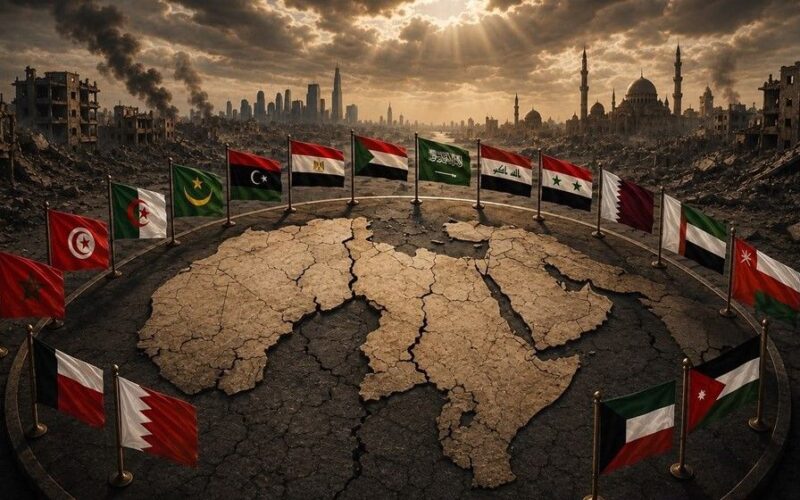
Despite all the crises the Arab world has experienced particularly since the invasion of Kuwait in the early 1990s and the war with Iran and despite the region’s continued exposure to attempts aimed at its systematic destruction, no one in the Arab world has succeeded in establishing a new Arab regional order. We have remained trapped in a cycle of going around in circles.
This is the most dangerous phase the Arab region has faced in 100 years. The crises could lead to gradual or comprehensive collapses, driven by wars, the emergence of regional centers of power such as Turkey, Iran, and Israel, and the internal erosion of states as a result of grievances, corruption, the absence of justice, and mounting debt.
At the same time, international powers appear intent on reshaping the region and dividing what is already divided into new maps based on influence, religion, ethnicity, sectarianism, and resources, as part of efforts to settle conflicts that were deliberately ignited among the people of the region.
There appears to be no Arab capacity on the horizon to build an alternative or new Arab regional order capable of protecting the region from these threats.
What we see today is each individual nation-state becoming increasingly absorbed in protecting its own interests by every possible means, or engaging in bilateral, trilateral, or quadrilateral relationships with allies inside or outside the region to safeguard those interests.
This suggests that reaching agreement on an Arab regional order has become exceedingly difficult.
One of the main reasons preventing the establishment of such an order is the state of discord among Arab countries, as well as their alignment with alternative regional or international centers of power instead of pursuing an Arab framework in which interests and threats can be addressed collectively and simultaneously.
The Arab League has failed to build such an order or strengthen the Arab regional system that was established in a weak and fragile form after World War II.
That system was largely the product of foreign arrangements imposed on the region and reinforced the isolation of states and peoples from one another, as though the independence of countries across the Arab Mashreq and Maghreb had come at the expense of the priority of building a unified Arab regional order.
Those who look back at history will discover, ironically, that the Arabs were in a much better position during the 1970s and 1980s than they are today, particularly in terms of their direct relations with one another and their recognition of the importance of keeping the region at the center of their national policies.
That situation began to deteriorate following the Iran-Iraq War, the occupation of Lebanon in 1982, and earlier developments rooted in the occupation of Palestine itself.
What can be said today is that the region is facing a scenario whose consequences remain unknown.
Nation-states will not remain capable of confronting crises on their own, relations between two or more countries will not be sufficient to address the challenges, and joint Arab action is not currently equipped to revive the region. The only possible alternative is the establishment of a new and alternative Arab regional order capable of confronting the dangers facing this region.
Without such an order, we will witness a completely different Arab world in 10 years, in which everyone will pay the price for failing to confront the crises and the price of dependency as well as though we are witnessing a slow surrender of the entire region.
Related Stories

Our Stolen Water

Public Debt: From Balance Management to Portfolio Management