
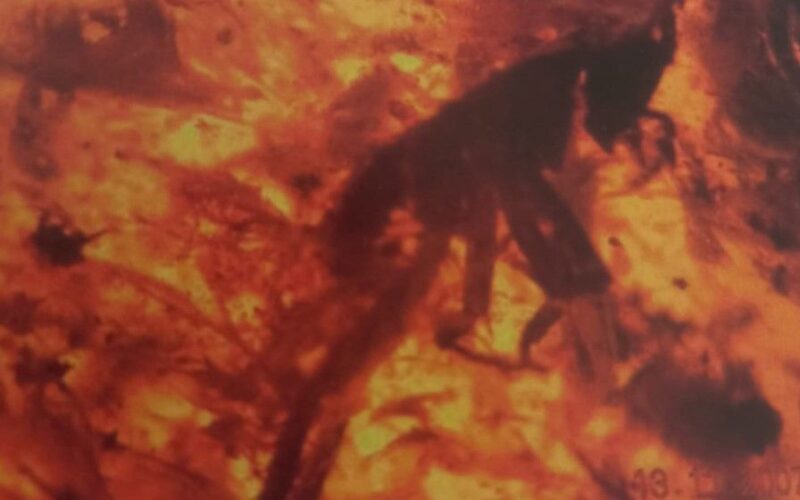
This insect, preserved in Jordanian amber, belongs to the plant hoppers (Hemiptera) and provides valuable evidence of the rich ecosystems that flourished approximately 140 million years ago during the Early Cretaceous Period.
Plant hoppers lay their eggs on plants. After hatching, the nymphs develop underground, feeding on plant roots, while the adults feed on plant sap using their piercing-sucking mouthparts.
The presence of this insect in Jordanian amber indicates that ancient forests in Jordan supported abundant vegetation capable of sustaining these specialized insects.
The remarkable preservation of this specimen in amber has allowed scientists to study its delicate anatomical features in exceptional detail. Such fossils make it possible to compare ancient plant hoppers with their modern relatives, providing important insights into the evolution of insects and the ecological relationships that existed in prehistoric forests.
Jordanian amber continues to reveal a remarkable record of ancient biodiversity and represents one of the most important natural archives for understanding terrestrial life during the Early Cretaceous.
The picture is a plant hopper preserved in Jordanian amber, a witness to life 140 million years ago.
Related Stories
On a Cabinet Reshuffle Without a Reason