
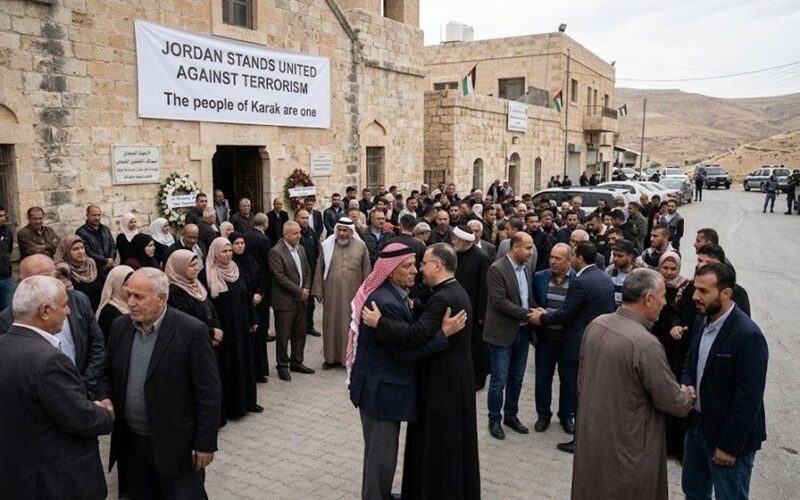
None of us could have imagined that the small, quiet town of Hamoud in northern Karak would become the scene of a bloody terrorist attack. Terrorism in its ISIS-inspired, takfiri form has once again come to the forefront in a horrific massacre that struck our people there and claimed the lives of innocent victims who had gathered to pray for the soul of a respected woman.
Shock, horror and disbelief are the words that best describe the feelings of the town’s residents, as well as those who survived the terrorist massacre and witnessed it. Everyone present at the funeral gathering at the church was a potential martyr. For dozens of people, only a few seconds separated life from death.
One is left bewildered and unable to explain what happened. Across Karak, everyone is asking the same question: How could you betray the bonds that united us, you vile people? A century of shared hardship and joy. A bond forged through poverty and suffering. A bond rooted in our Jordanian homeland, which offered the Arab East a rare example of coexistence, brotherhood, love and citizenship.
Here, one realises just how dangerous takfiri ideology is to society. It strips people of their humanity and drives them to commit crimes against their neighbours and their own communities. This ISIS-style model is not new. For many years, this monstrous ideology was cultivated in the laboratories of states and regimes, in environments that absorbed the worst ideas about religious beliefs, and in settings that tolerated and colluded with rhetoric of takfir and hatred flooding social media platforms. Some were ultimately driven to kill members of their own families, enslave and rape women, and burn people alive.
The Hamoud church massacre belongs to this same model of savagery, which we had believed was defeated and had receded with the decline of its era and its sponsors.
Yet despite its brutality and all its cruelty and treachery, the massacre did not break the will of our people in Hamoud. Just hours after the horrific event that shook the country, the town became a symbol for all of Jordan. Everyone was sending the same message: we will not submit to terrorism or terrorists, and we will not allow their agenda and objectives to prevail. People repeated the same words: we are not a minority; we are part of the Jordanian majority that has played an honourable role in the history and development of our country. What happened was an attack on Jordan and its people, regardless of their origins. It was an attack on the state and the rule of law, accompanied by confidence that the state would bring the criminals to justice and that the long arm of justice would reach them.
Jordanians rose to the occasion. Using every means of expression and action available to them, they embraced Hamoud and Karak with feelings of love and national solidarity. On that bloody Friday, Karak did not feel alone, and the people of Hamoud did not feel they lived in a small village. They felt they were in a large home called Jordan.
The people of Karak responded with a strength befitting Jordan. The moment of the massacre was decisive and defining. It tested the depth of our national spirit, unity and social resilience. We successfully endured those difficult hours while blood was still filling the church grounds. Jordan and its people did not allow the terrorists, even for a single moment, to feel victorious or to write their own chapter in history. Within minutes of the massacre, they were fleeing like mice from an inevitable fate.
Jordan has never before witnessed a terrorist act of this kind, apart from the hotel bombings two decades ago. This attack has distinctive characteristics that will also have repercussions in the days ahead. We are entering a period in which our national resolve, our ability to protect our national project, and the values targeted by the terrorists will be put to the test.
Related Stories

Three’s a Crowd Except When It Comes to Waste Collection in Amman