
As nearly two years approach since the formation of Dr. Jaafar Hassan’s government, the government’s announcement of what it has accomplished presents public opinion with an important opportunity to redefine the concept of government accountability.
Accountability is a constitutional right and a fundamental tool for improving public performance, but it is far more useful when it starts from facts and commitments, not from personalization or side details unrelated to the substance of government work.
The government itself set a clear standard from the outset when it presented its ministerial statement, affirming that it would work to implement its program and be held accountable on that basis. That is why today’s question should be: what did the government promise? What has it achieved? Has it met its targets? What has been delayed, and why?
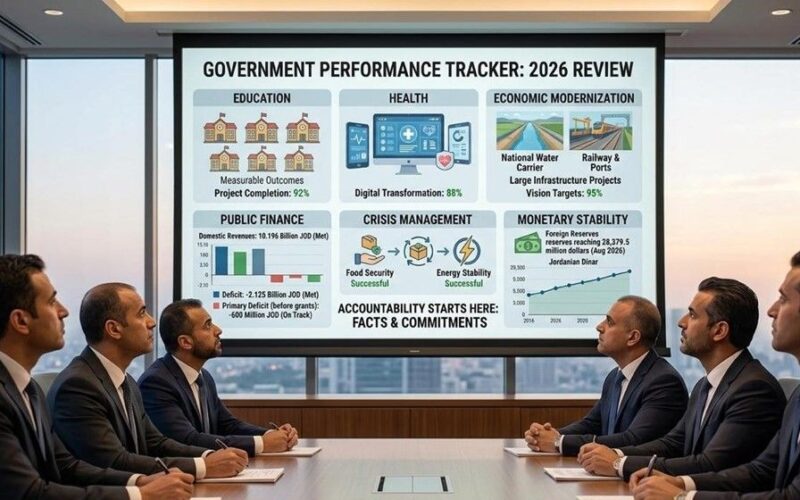
In education, there are measurable numbers and projects. Were new schools built and school buildings expanded, were rented buildings vacated as targeted, alongside the expansion of BTEC vocational and technical education? The government also allocated 35 million dinars to the university student support fund, and direct support of 80 million dinars to public universities in the 2026 budget. Has the targeted impact been achieved?
In health, accountability should cover the level of implementation of digital transformation at the Ministry of Health, the expansion of health centers, the health insurance project, and the cancer treatment program, alongside hospital projects and the rehabilitation of outpatient clinics in the governorates. The digital health transformation project, funded by the Abu Dhabi Fund for Development with 100 million dollars and including the virtual hospital, health data exchange, and remote care services, where has its implementation reached?
On the economic front, accountability should extend to the economic modernization vision and its major projects: the National Carrier for water, railways and ports, the development of the Risha gas field, renewable energy projects, Amra City, and investment and public private partnership projects, given that the second executive program includes 392 projects, with expected investments approaching 10 billion dinars from private sector partnerships. Where has implementation reached?
In public finance, accountability should cover implementation of the budget law, controlling the deficit, spending efficiency, the trajectory of public debt, and increasing revenues without burdening the citizen, as well as the degree of commitment to the economic reform program supported by the IMF. Is the program on track? What progress has been made on structural reforms? Are the targets of the 2026 budget being met: domestic revenues of 10.196 billion dinars, a post grants deficit of about 2.125 billion, and a primary deficit before grants of about 600 million? Is the debt ratio moving toward the government’s target of reducing it to below 80% by 2028?
The test of crisis management should not be overlooked either. Jordan faced the fallout of the regional war and disruptions to supply chains, energy, and trade, and the standard for success was protecting food and energy security and the continuity of markets and services. Did petroleum derivatives run short when gas supply was cut off?
And in the governorates, were the field visits translated into improved services and accelerated projects? Were commitments carried out on schedule?
Alongside all this, did the Central Bank maintain monetary stability and the stability of the dinar’s exchange rate, backed by foreign reserves reaching 28,379.5 million dollars by the end of August 2026, while continuing its role in managing liquidity, containing inflationary pressures, and strengthening the economy’s ability to withstand external shocks?
This is the kind of accountability Jordan needs: accountability measured in numbers, in deadlines, in completion rates, and in impact on the citizen and the economy.
As for personalization and searching for faults outside the scope of government responsibility, this will produce neither reform nor development. The government is not just individuals; it is a program, commitments, a budget, decisions, and projects.
Whoever wants to evaluate it after two years should open its ministerial statement and executive programs, and place what it pledged alongside what it has achieved. Only then does accountability become fair, professional, and useful to both the state and the citizen.
Related Stories

A Sensitive Issue No One Talks About

Isolating Iran: The Most Dangerous File at the G20 Summit