

The most important standard for evaluating the quality of governments in Jordan is no longer what it used to be. A fundamental shift has taken place, driven by numerous challenges — foremost among them the economic challenge and the need for a development model capable of addressing chronic and urgent problems such as unemployment, poverty, the rising cost of living, indebtedness, and declining service levels, among many others.
The executive efficiency of the government team is now the new standard — not political experience or party affiliation.
In established democracies, parties compete on their programs to win majority support and govern through parliament. But when they come to power, they field a ministerial team that generally draws from diverse backgrounds and specializations suited to the nature of each ministerial portfolio.
Jordan has not yet reached this stage, nor are we close to it. Our party experience still lacks the traditions that would elevate it to the ranks of democratic nations. And across the Arab world in general, no experience has been recorded as a unique exception to this rule.
What we can currently rely on to accomplish the tasks of modernization and gradual transition toward better governance mechanisms is a prime minister’s program — not a party — to manage this phase. This is not a new tradition for Jordan. Every pivotal milestone in which the Kingdom witnessed economic and developmental progress has been tied to the names of leading figures who formed governments staffed mostly by people of executive competence and specialized expertise, alongside an accompanying condition for all of that: integrity and reputation.
At times, we have had prime ministers with what might be called “charisma,” but who lacked a clear program; at other times, they had a program but failed to secure a team with executive competence.
It used to be said that “the government is [defined by] its head.” This is a correct statement that needs some adjustment, since experience has shown that without a team that understands the prime minister, embraces his program, and is capable of execution, the prime minister will quickly become exhausted and drop out of the race.
There is a general impression that at this stage, we have been fortunate to have a prime minister and a ministerial team who genuinely embody the principle of executive efficiency as the basis for government work. One can note many observations about government performance, as is the case with every previous and subsequent government, but one cannot deny the major change that has occurred in how the executive branch operates and its ability to deliver on what it promised in its program.
A few days ago, my colleague Salama Al-Der’awi published an important economic analysis in Al-Ghad addressing the government’s handling of the public debt file and the preliminary results it has produced over a single year.
The analysis showed that the continuous rise in public debt servicing and its interest is not an inevitable fate. The equation, in short: public debt may rise annually, but debt servicing can decline at rates that create an opportunity to curb the growth of indebtedness over the coming years, in an unprecedented way. Herein lies the value of executive efficiency in managing a major file that weighs heavily on the state and society.
Not far from that example are multiple instances of successive government decisions showing that having effective executive leadership is enough to remove obstacles facing development, economic, and service projects — projects that in the past were achieved only with great difficulty, and often after the Jordanian public had already lost confidence in the project and its value and importance.
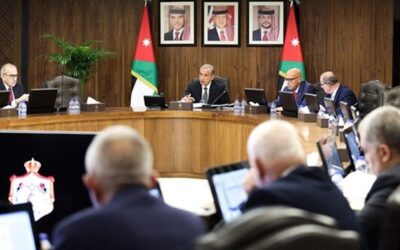
Weekly Cabinet meetings used to pass without the slightest attention, even from the media. Today, every meeting carries a package of decisions that the media cannot ignore. More importantly, their impact reaches the street immediately.
Related Stories
Antibiotic enters Jordanian government's body
Inflation: A New Test of the Economy’s Resilience