
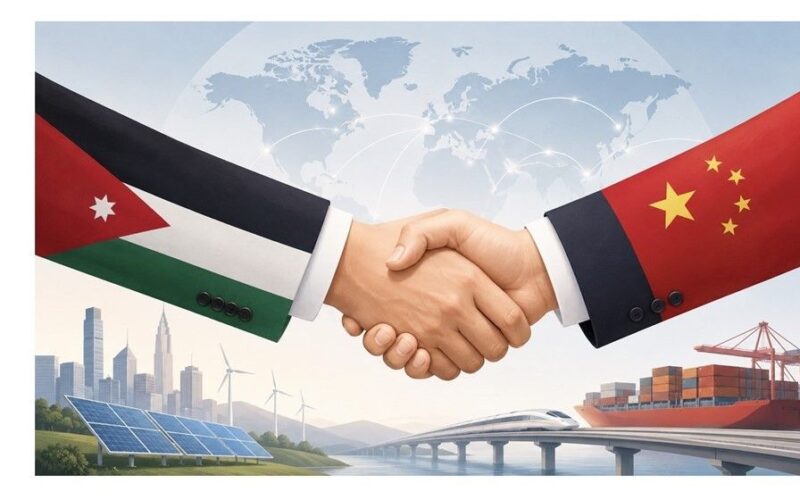
King Abdullah
II’s visit to China comes at an international moment whose significance extends
well beyond bilateral relations between the two countries. The world is
undergoing tangible shifts in the balance of economic and political power, with
the Western dominance led by the United States that characterized previous
decades gradually receding, while China is rising and a number of Global South
countries are assuming a growing role in the world economy and in shaping
international balances.
From this
perspective, the visit carries particular importance for Jordan, which needs to
broaden its network of economic and strategic partnerships in ways that advance
its interests and strengthen its ability to navigate an increasingly multipolar
and complex world.
Jordanian
Chinese relations are not starting from scratch. There are already successful
experiences of cooperation and economic partnership that can be built upon and
expanded, whether in infrastructure, energy, industry, or various fields of
investment. The challenge in the coming phase, therefore, is not simply to open
new channels, but to take the existing relationship to a deeper and more
diversified level, so that China becomes a more prominent economic, investment,
and production partner in the Jordanian economy, rather than remaining
primarily one of Jordan’s major trading partners and sources of imports.
Jordan needs
this kind of partnership. The national economy continues to face high
unemployment, relatively weak levels of productive investment, and a limited
base of high-value-added industries.
Expanding Chinese investment in Jordan
could therefore create opportunities to strengthen manufacturing, facilitate
technology transfer, and develop sectors such as renewable energy, energy
storage, electrical and digital industries, transport, and logistics. Jordan
could also leverage its geographic location and trade agreements to access
regional and international markets.
Realizing
these gains, however, requires a more proactive Jordanian policy in managing
its economic relationship with China, Jordan needs to identify priority sectors
more clearly, develop concrete and implementable investment projects, and link
investment incentives to job creation, knowledge and technology transfer,
increased local content in production inputs, and stronger export capacity.
In
this way, foreign investment can become a genuine driver of growth and
production rather than remaining limited to financial inflows or projects with
only a modest impact on the domestic economy.
This is where
the importance of diversifying Jordan’s economic and strategic partners becomes
particularly clear, at a time when the global economic and political order is
being reshaped, it is no longer prudent for small and medium-sized countries to
tie their options to a limited number of international power centres.
What is
needed is a restructuring of Jordan’s economic and political relationships
around the principle of national interest, alongside balanced engagement with
the various influential powers in the world, including China, Western
countries, emerging Asian powers, and other countries of the Global South.
Such an
approach is not based on aligning with one international camp against another.
Rather, it is about expanding options, strengthening negotiating capacity, and
safeguarding national interests.
The more diversified Jordan’s economic and
strategic partnerships become, the greater its ability to attract investment,
diversify markets, gain access to technology and financing, and reduce its
exposure to volatility resulting from excessive dependence on specific partners
or markets.
From a
broader perspective, strengthening Jordanian Chinese relations is consistent
with ongoing calls and shifts toward a more multipolar and equitable
international order.
For Jordan, as a country of the Global South, active
engagement with these transformations could widen the space for its economic
and political choices and contribute to building international relations that
are more balanced and fairer.
Related Stories

When Military Rank Loses Its Honor

The Influence of Gravity on Living Organisms and the Evolution of Life